

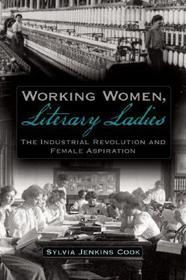
Working Women, Literary Ladies
The Industrial Revolution and Female Aspiration
- Publisher's listprice GBP 32.49
-
15 522 Ft (14 782 Ft + 5% VAT)
The price is estimated because at the time of ordering we do not know what conversion rates will apply to HUF / product currency when the book arrives. In case HUF is weaker, the price increases slightly, in case HUF is stronger, the price goes lower slightly.
- Discount 10% (cc. 1 552 Ft off)
- Discounted price 13 969 Ft (13 304 Ft + 5% VAT)
Subcribe now and take benefit of a favourable price.
Subscribe
15 522 Ft

Availability
printed on demand
Why don't you give exact delivery time?
Delivery time is estimated on our previous experiences. We give estimations only, because we order from outside Hungary, and the delivery time mainly depends on how quickly the publisher supplies the book. Faster or slower deliveries both happen, but we do our best to supply as quickly as possible.
Product details:
- Publisher OUP USA
- Date of Publication 21 February 2008
- ISBN 9780195327816
- Binding Paperback
- No. of pages304 pages
- Size 231x155x20 mm
- Weight 431 g
- Language English 0
Categories
Short description:
This book explores the simultaneous entry of working-class women in the United States into wage-earning factory labour and into opportunities for mental and literary development. It traces the hopes and tensions generated by expectations of their gender and class from the first New England operatives in the early nineteenth century to immigrant sweatshop workers in the early twentieth.
MoreLong description:
This book explores the mental and literary awakening that many working-class women in the United States experienced when they left the home and began to work in factories early in the nineteenth century. Cook also examines many of the literary productions from this group of women ranging from their first New England magazine of belles lettres, The Lowell Offering, to Emma Goldman's periodical, Mother Earth; from Lucy Larcom's epic poem of women factory workers, An Idyl of Work, to Theresa Malkiel's fictional account of sweatshop workers in New York, The Diary of a Shirtwaist Striker.
Working women's avid interests in books and writing evolved in the context of an American romanticism that encouraged ideals of self-reliance that were not formulated with factory girls in mind. Their efforts to pursue a life of the mind while engaged in arduous bodily labour also coincided with the emergence of middle-class women writers from private and domestic lives into the literary marketplace. However, while middle-class women risked forfeiting their status as ladies by trying to earn money by becoming writers, factory women were accused of selling out their class credentials by trying to be literary.
Cook traces the romantic literariness of several generations of working-class women in their own writing and the broader literary responses of those who shared some, though by no means all, of their interests. The most significant literary interaction, however, is with middle-class women writers. Some of these, like Margaret Fuller, envisioned ideals of female self-development that inspired, without always including, working women. Others, like novelists Davis, Phelps, Alcott, and Scudder, created compassionate fictions of their economic and social inequities but balked at promoting their artistic and intellectual equality.
Cook's investigation of the literariness of women workers in industrializing America produces a revelatory cultural narrative. Her examination of the tension between 'the life of the mind' and the 'life of the body' as this is played out over time and populations allows her to distill and highlight the complex interaction of gender and class. Opening up an array of associations, literal and imaginative, political and literary, Cook contributes significantly to the burgeoning work on the history of class in the U.S.
Table of Contents:
Introduction -"Mind amongst the Spindles"
"A Tangled Skein": Early Factory Women, Self-Reliance, and Self-Sacrifice
"Ideal Mill Girls: The Lowell Offering and Female Aspiration
Across the Gulf: The Transcendentalists, the Dial, and Margaret Fuller
The Prospects for Fiction: Male Romantic Novelists and Women's Social Reality
Fables of Lowell: The First Factory Fictions
The Working Woman's Bard: Lucy Larcom and the Factory Epic
Full Development or Self-Restraint: Middle-Class Women and Working-Class Elevation
"Beautiful Language and Difficult Ideas": From New England Factory to New York Sweatshop

