

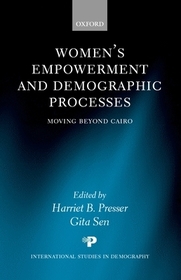
Women's Empowerment and Demographic Processes
Moving Beyond Cairo
Series: International Studies in Demography;
- Publisher's listprice GBP 207.50
-
93 686 Ft (89 225 Ft + 5% VAT)
The price is estimated because at the time of ordering we do not know what conversion rates will apply to HUF / product currency when the book arrives. In case HUF is weaker, the price increases slightly, in case HUF is stronger, the price goes lower slightly.
- Discount 10% (cc. 9 368 Ft off)
- Discounted price 84 318 Ft (80 303 Ft + 5% VAT)
Subcribe now and take benefit of a favourable price.
Subscribe
93 686 Ft

Availability
printed on demand
Why don't you give exact delivery time?
Delivery time is estimated on our previous experiences. We give estimations only, because we order from outside Hungary, and the delivery time mainly depends on how quickly the publisher supplies the book. Faster or slower deliveries both happen, but we do our best to supply as quickly as possible.
Product details:
- Publisher OUP Oxford
- Date of Publication 31 August 2000
- ISBN 9780198297314
- Binding Hardback
- No. of pages440 pages
- Size 242x164x28 mm
- Weight 762 g
- Language English
- Illustrations 5 line drawings 0
Categories
Short description:
This volume extends the research programme on women's empowerment originally brought to prominence at the Cairo International Conference on Population and Development in 1994. Contributors spanning a broad geographical scope have been brought together by editors Harriet Presser and Gita Sen, creating a book that refines the definition of the concept of empowerment and how it can be measured. In addition, it examines how useful it has been in the understanding of demographic process, and evaluates the usefulness of the concept for establishing population policies. It will be of interest to readers in both the research and policy communities.
MoreLong description:
There is general consensus among the international population community that the commitment achieved at the International Conference on Population and Development (Cairo, 1994) to womens empowerment, along with the related goals of improving womens reproductive health and securing their reproductive rights, represented a paradigm shift in the discourse about population and development, even though there are differences in view whether this is a positive change or not. But while the rhetoric about womens empowerment is pervasive, the concept remains ill-defined, and its relationship to demographic processes has not been well articulated, either theoretically or empirically. This book brings together leading researchers and policy advocates to explore whether the concept of womens empowerment is indeed useful for an understanding of key demographic processes. Its contributors identify new directions for demographic research from the analysis of available data that measure womens empowerment, and point to the implications for population-related policies.
Demographic research has focused relatively little to date on gender, let alone the question of power. Yet critiques of available data argue that traditional womens-status indicators, such as education and employment, are often not sensitive enough to capture the nuances of gender power relations and the ways in which they govern womens and mens reproductive behaviour. This book moves forward to the complex task of conceptualizing, measuring, and analysing womens empowerment. In laying this groundwork, it provides critically important insights into the causes and consequences of population change, including migration. The book combines conceptual and empirical research with policy directions and considers the relevance of economic, social, and cultural contexts for the health and well-being of women, adolescents, and children. The countries under study are of both the North and the South. This book represents state-of-the-art knowledge on the two-way linkages between womens empowerment and demographic processes.
Excellent and long-overdue collection of essays ... In their introductory essay, Presser and Sen provide an admirable overview.
Table of Contents:
Part I. Introduction
Women's Empowerment and Demographic Processes: Laying the Groundwork
Part II. Theoretical Perspectives on Women's Empowerment
Empowering Women for Reproductive Rights
Conceptualizing Women's Empowerment in Countries of the North
Part III. Women's Empowerment and Reproductive Health
Reproductive Health and the Demographic Imagination
Empowering Women through the Policy Process: The Making of Health Policy in South Africa
Empowerment of Women in Egypt and Links to the Survival and Health of Their Infants
Part IV. Women's Empowerment and Socio-Demographic Processes
The Consequences of Female Empowerment for Child Well-Being: A Review of Concepts, Issues, and Evidence in a Post-Cairo Context
Female Empowerment and Adolescent Demographic Behaviour
Women's Autonomy in Rural India: Its Dimensions, Determinants, and the Influence of Context
The Role of Gender Context in Shaping Reproductive Behaviour in Nigeria
Economic Restructuring, Women's Work, and Autonomy in Mexico
Migration and Women's Empowerment
Women's Empowerment, Marriage Postponement, and Gender Relations in Japan: An Intergenerational Perspective
Part V. Future Directions for Population Policy
Population Policy and Women's Empowerment: Challenges and Opportunities
Appendix. Demography, Feminism, and the Science-Policy Nexus

