

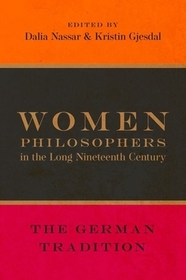
Women Philosophers in the Long Nineteenth Century
The German Tradition
- Publisher's listprice GBP 34.99
-
15 797 Ft (15 045 Ft + 5% VAT)
The price is estimated because at the time of ordering we do not know what conversion rates will apply to HUF / product currency when the book arrives. In case HUF is weaker, the price increases slightly, in case HUF is stronger, the price goes lower slightly.
- Discount 10% (cc. 1 580 Ft off)
- Discounted price 14 218 Ft (13 541 Ft + 5% VAT)
Subcribe now and take benefit of a favourable price.
Subscribe
15 797 Ft

Availability
Estimated delivery time: In stock at the publisher, but not at Prospero's office. Delivery time approx. 3-5 weeks.
Not in stock at Prospero.
Why don't you give exact delivery time?
Delivery time is estimated on our previous experiences. We give estimations only, because we order from outside Hungary, and the delivery time mainly depends on how quickly the publisher supplies the book. Faster or slower deliveries both happen, but we do our best to supply as quickly as possible.
Product details:
- Publisher OUP USA
- Date of Publication 12 October 2021
- ISBN 9780190868048
- Binding Paperback
- No. of pages334 pages
- Size 236x157x20 mm
- Weight 499 g
- Language English 136
Categories
Short description:
This volume makes available to English-language readers--in many cases for the first time--the works of nine women philosophers from the German tradition. It showcases their contemporary relevance and their crucial contributions to nineteenth-century philosophical movements. An Editors' Introduction offers a comprehensive overview of the contributions of women philosophers in the Nineteenth Century. Each chapter is furnished with an introduction to the distinctive life and work of the philosopher in questions. The translated texts are accessible and engaging. The translations are furnished with explanatory footnotes. This is a good fit for courses in 19th Century Philosophy which can sometimes be called 19th Century German (or European) Philosophy, as it's very German-heavy. That is a course that is a vast majority of philosophy departments and required for majors. The purpose of the book is to give people texts to use and assign to diversify syllabi in this area since usually it's just about Nietzsche, Schopenhauer, and the like, and no women. For surveys of the History of Philosophy in general, this could also be a core text for people looking to diversify (in terms of gender) their offerings, since 19th Century (German) philosophy is usually such a major part of those courses given the importance of the work that was done then-again this book allows people to diversify their syllabus.
MoreLong description:
The long nineteenth-century--the period beginning with the French Revolution and ending with World War I--was a transformative period for women philosophers in German-speaking countries and contexts. The period spans romanticism and idealism, socialism, Nietzscheanism, and phenomenology, philosophical movements we most often associate with Hegel, Schopenhauer, Kierkegaard, Nietzsche, and Marx--but rarely with women. Yet women philosophers not only contributed to these movements, but also spearheaded debates about their social and political implications. While today their works are less well-known than those of their male contemporaries, many of these women philosophers were widely-read and influential in their own time. Their contributions shed important new light on nineteenth-century philosophy and philosophy more generally: revealing the extent to which various movements which we consider distinct were joined, and demonstrating the degree to which philosophy can transform lives and be transformed by lived experiences and practices.
In the nineteenth century, women philosophers explored a wide range of philosophical topics and styles. Working within and in dialogue with popular philosophical movements, women philosophers helped shape philosophy's agenda and provided unique approaches to existential, political, aesthetic, and epistemological questions. Though largely deprived formal education and academic positions, women thinkers developed a way of philosophizing that was accessible, intuitive, and activist in spirit. The present volume makes available to English-language readers—in many cases for the first time—the works of nine women philosophers, with the hope of stimulating further interest in and scholarship on their works. The volume includes a comprehensive introduction to women philosophers in the nineteenth century and introduces each philosopher and her position. The translations are furnished with explanatory footnotes. The volume is designed to be accessible to students as well as scholars.
...a much-needed contribution to literature on the history of philosophy
Table of Contents:
Editors' Introduction
Translation, Acknowledgements, Sources
Chapter One: Germaine de Staël
Introduction
On Women Writers
Kant
On the Influence of the New Philosophy on the Sciences
Chapter Two: Karoline von Günderrode
Introduction
Fichte's TheVocation of Humankind
Philosophy of Nature
The Idea of Nature
The Idea of the Earth
Chapter Three: Bettina Brentano von Arnim
Introduction
Günderode
Chapter Four: Hedwig Dohm
Introduction
Nietzsche and Women
The New Mother
The Old Woman
On the Sexual Morality of Women
Chapter Five: Clara Zetkin
Introduction
For the Liberation of Women
Women's Suffrage
Save the Scottsboro Boys!
Chapter Six: Lou Salomé
Introduction
Selections from The Erotic
Chapter Seven: Rosa Luxemburg
Introduction
Wage Labor, selections from Introduction to Political Economy
Chapter Eight: Edith Stein
Introduction
Selections from On Empathy
Chapter Nine: Gerda Walther
Introduction
A Contribution to the Ontology of Social Communities (selections)
Bibliography for Editors' Introductions
Bibliography for Translated Text

