

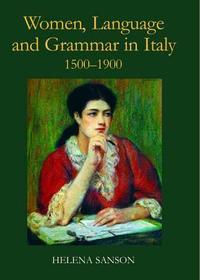
Women, Language and Grammar in Italy, 1500-1900
Series: British Academy Monographs;
- Publisher's listprice GBP 90.00
-
40 635 Ft (38 700 Ft + 5% VAT)
The price is estimated because at the time of ordering we do not know what conversion rates will apply to HUF / product currency when the book arrives. In case HUF is weaker, the price increases slightly, in case HUF is stronger, the price goes lower slightly.
- Discount 10% (cc. 4 064 Ft off)
- Discounted price 36 572 Ft (34 830 Ft + 5% VAT)
Subcribe now and take benefit of a favourable price.
Subscribe
40 635 Ft

Availability
Estimated delivery time: In stock at the publisher, but not at Prospero's office. Delivery time approx. 3-5 weeks.
Not in stock at Prospero.
Why don't you give exact delivery time?
Delivery time is estimated on our previous experiences. We give estimations only, because we order from outside Hungary, and the delivery time mainly depends on how quickly the publisher supplies the book. Faster or slower deliveries both happen, but we do our best to supply as quickly as possible.
Product details:
- Publisher The British Academy
- Date of Publication 8 September 2011
- ISBN 9780197264836
- Binding Hardback
- No. of pages432 pages
- Size 241x170x11 mm
- Weight 926 g
- Language English
- Illustrations 32 illustrations 0
Categories
Short description:
In the sixteenth century Italian was a literary language not accessible to the less educated, among them women, who would instead speak a local dialect. Little attention has been paid to women's linguistic education, but this study shows the vital role they played in developing Italian as a true mother tongue.
Long description:
This monograph examines the relationship between women, language and grammar with particular reference to the Italian context between the sixteenth and the end of the nineteenth century, from the codification of Italian as a literary language to the formation of a unified state. It investigates the role played by women in the Italian linguistic tradition as addressees, readers or authors of grammatical texts.
In spite of the ever-growing interest in different aspects of women's life in the Western world through the centuries, little attention has been given up to now to women's linguistic education, their relationship with grammar and the ideas about their use of language. In the context of Italy, these questions were virtually unexplored.
This study is the result of extensive first-hand research and detailed analysis of primary sources (well-known texts, as well as minor and rare ones), brought together for the first time and made available to a wider public. Sources range from more specifically linguistic writings, to texts on women's education and conduct books, from literary works (e.g. novels, short-stories, poetry, plays, satirical writings, children's literature), to official government documents, newspapers articles, women's magazines, school texts, letters and memoirs.
Its interdisciplinary approach and the richness of its sources make this volume an engaging journey across four centuries in the history of the Italian language the history of grammar, the history of linguistic thought, and the history of women and their education. This is the first work of its kind in the field of Italian studies. Relevant illustrations accompany the book offering readers also a visual appreciation and understanding of the subjects and themes examined in the six chapters.
This excellent study ... [is] a thorough and original treatment of a hitherto unexplored aspect of Italian linguistic and literary history. ... It will surely become a standard reference for scholars in linguistic and women's history alike. More
Table of Contents:
- Prologue: On Grammar and Women
- 1: Grammatica: the key to knowledge
- 2: The Spoken Language, the Written Language
- 3: The Scope of this Book
- PART I (Sixteenth-Seventeenth Centuries)
- 1: Women, the Vernacular, and Classical Languages
- 2: Women and Vernacular Grammar
- PART TWO (Eighteenth-Early Nineteenth Centuries)
- 3: Women and Language in the Secolo delle donne
- 4: Knowledge and Language 'for the ladies'
- PART THREE (The Nineteenth Century)
- 5: Women and the Mother Tongue in the Ottocento
- 6: Women Writing on Language
- Epilogue

