

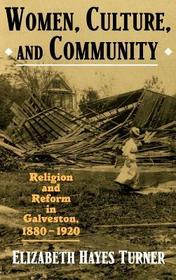
Women, Culture, and Community
Religion and Reform in Galveston, 1880-1920
- Publisher's listprice GBP 57.00
-
27 231 Ft (25 935 Ft + 5% VAT)
The price is estimated because at the time of ordering we do not know what conversion rates will apply to HUF / product currency when the book arrives. In case HUF is weaker, the price increases slightly, in case HUF is stronger, the price goes lower slightly.
- Discount 10% (cc. 2 723 Ft off)
- Discounted price 24 509 Ft (23 342 Ft + 5% VAT)
Subcribe now and take benefit of a favourable price.
Subscribe
27 231 Ft

Availability
printed on demand
Why don't you give exact delivery time?
Delivery time is estimated on our previous experiences. We give estimations only, because we order from outside Hungary, and the delivery time mainly depends on how quickly the publisher supplies the book. Faster or slower deliveries both happen, but we do our best to supply as quickly as possible.
Product details:
- Publisher OUP USA
- Date of Publication 11 December 1997
- ISBN 9780195086881
- Binding Hardback
- No. of pages384 pages
- Size 162x238x29 mm
- Weight 798 g
- Language English
- Illustrations 27 halftones 0
Categories
Long description:
In this work, Elizabeth Turner addresses a central question in post-Reconstruction social history: why did middle-class women expand their activities from the private to the public sphere and begin, in the years just before World War I, an unprecedented activism? Using Galveston as a case study, Turner examines how a generally conservative, traditional environment could produce important women's organizations for Progressive reform. She concludes that the women of Galveston, though slow to respond to national movements, were stirred to action on behalf of their local community. Local organizations, particularly Episcopal and Presbyterian churches, and traditional everyday social activities provided a nurturing environment for budding reformers, and a foundation for activist organizations and programs such as poor relief and progressive reform. Ultimately, women became politicized even as they continued their roles as guardians of traditional domestic values.
Women, Culture, and Community will appeal to scholars and students of the post-Reconstruction South, women's history, activist history, and religious history.

