

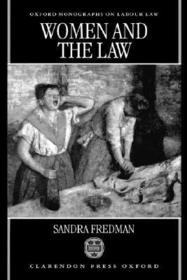
Women and the Law
Series: Oxford Labour Law;
- Publisher's listprice GBP 95.00
-
42 892 Ft (40 850 Ft + 5% VAT)
The price is estimated because at the time of ordering we do not know what conversion rates will apply to HUF / product currency when the book arrives. In case HUF is weaker, the price increases slightly, in case HUF is stronger, the price goes lower slightly.
- Discount 10% (cc. 4 289 Ft off)
- Discounted price 38 603 Ft (36 765 Ft + 5% VAT)
Subcribe now and take benefit of a favourable price.
Subscribe
42 892 Ft

Availability
printed on demand
Why don't you give exact delivery time?
Delivery time is estimated on our previous experiences. We give estimations only, because we order from outside Hungary, and the delivery time mainly depends on how quickly the publisher supplies the book. Faster or slower deliveries both happen, but we do our best to supply as quickly as possible.
Product details:
- Publisher Clarendon Press
- Date of Publication 8 January 1998
- ISBN 9780198763222
- Binding Hardback
- No. of pages466 pages
- Size 243x164x29 mm
- Weight 838 g
- Language English 0
Categories
Short description:
Women are still far from equal to men yet discrimination on the grounds of sex is unlawful. In this compelling, new book, Sandra Fredman asks the question: why has the law had so little impact? She argues that it is due to inherent limitations within the legal framework. In particular, the law is unable to address the division of labour within the family, a factor which continues to prove a serious impediment to women's progress. The author concludes that only when this caring work is properly valued, and men and women participate equally in both family life and the paid workforce will real progress in the arena of sexual equality be made.
MoreLong description:
As the millennium draws to a close, it is clear that equality between men and women remains a pipe-dream. Thus argues Sandra Fredman in her stimulating, new book on women and the law. Women's pay still lags significantly behind that of men; and women continue to congregate in low status, low paid jobs. Yet men and women are now formally equal before the law: indeed, legislation positively outlawing discrimination has been in force for over two decades both in the UK and the European Union. The key question asked by the author is: Why has the law had so little impact? The answer, the author argues, lies in the structure of the law itself. In a wide-ranging examination of sources drawn from political theory, social history and law, the first part of the book develops a critical framework to illuminate the limitations of the law in addressing women's disadvantaged status. In particular, the author unmask the apparent objectivity and neutrality of law, exposing the assumptions which have systematically impeded women's progress. Part II of the book applies this critique to a detailed examination of key legal issues in the UK and EU, with illuminating references to the law in North America and Australia. The result is an original and incisive analysis of pressing legal issues ranging from low pay, sexual harassment and flexible working to parenting rights and reverse discrimination. The book locates women's role in the family as a key contributory factor to their continued disadvantage within the paid workforce. Yet, in signalling the way forward, the author rejects the notion that the aim is simply to slot more women into existing structures. Instead of expecting women to conform to structures which exclude and devalue caring responsibilities, she argues, real change will only occur if paid work is restructured so that both men and women can be active participants in family life as well as in the paid workforce. The book does not, however, offer single dimensional solutions. In particular, the very difficult conflicts of interest which can arise between women, on grounds such as class or race, are directly confronted.
There can be no doubt whatever that this is a superb book and an outstanding contribution to feminist jurisprudence. It ably fulfils the challenging task which it set itself and makes a cogent and eloquent plea for radical legislative reform./ a truly ground-breaking work and - not just that - it is also a gripping read! / Evelyn Ellis, University of Birmingham, Industrial Law Journal Vol. 27, Sept. 1998.
Table of Contents:
One: Myths and Messages
Two: Theoretical Perspectives
Three: Past and Present: Legal Developments
Four: Past and Present: Women's Work
Five: Women Today
Six: Pregnancy and Parenthood
Seven: The State of Pay
Eight: Structural Disadvantage
Nine: Enduring Disadvantage
Ten: The Role of Law

