

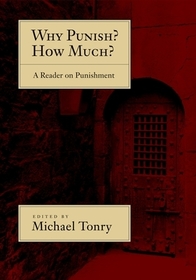
Why Punish? How Much?
A Reader on Punishment
- Publisher's listprice GBP 65.00
-
29 347 Ft (27 950 Ft + 5% VAT)
The price is estimated because at the time of ordering we do not know what conversion rates will apply to HUF / product currency when the book arrives. In case HUF is weaker, the price increases slightly, in case HUF is stronger, the price goes lower slightly.
- Discount 10% (cc. 2 935 Ft off)
- Discounted price 26 413 Ft (25 155 Ft + 5% VAT)
Subcribe now and take benefit of a favourable price.
Subscribe
29 347 Ft

Availability
printed on demand
Why don't you give exact delivery time?
Delivery time is estimated on our previous experiences. We give estimations only, because we order from outside Hungary, and the delivery time mainly depends on how quickly the publisher supplies the book. Faster or slower deliveries both happen, but we do our best to supply as quickly as possible.
Product details:
- Publisher OUP USA
- Date of Publication 13 January 2011
- ISBN 9780195328868
- Binding Paperback
- No. of pages456 pages
- Size 249x178x30 mm
- Weight 794 g
- Language English
- Illustrations 3 black and white illustrations 0
Categories
Short description:
Why Punish? How Much? is a collection of key readings on punishment and its effects on individuals and society as a whole. In addition to both classic and contemporary writings on normative theories by philosophers and penal theorists, it includes sections on restorative justice, on how people think about punishment, and on social theories about the functions punishment performs in human societies.
MoreLong description:
Punishment is a complex human institution. It has normative, political, social, psychological, and legal dimensions, and ways of thinking about each of them change over time. For this reader on punishment, Michael Tonry, a leading authority in the field, has composed a comprehensive collection of 28 essays ranging from classic and contemporary writings on normative theories by philosophers and penal theorists to writings on restorative justice, on how people think about punishment, and on social theories about the functions punishment performs in human societies.
This volume includes an accessible, non-technical introduction on the development of punishment theory, as well as an introduction and annotated bibliography for each section. The readings cover foundational traditions of punishment theory such as consequentialism, retributivism, and functionalism, new approaches like restorative, communitarian, and therapeutic justice, as well as mixed approaches that attempt to link theory and policy. It follows the evolution and development of thinking about punishment spanning from writings by classical theorists such as Kant and Hegel to recent developments in the behavioral and medical sciences for thinking about punishment. The result is a collection of empirically-informed efforts to explain what punishment does that should spark contemplation and debate about why and how punishment is carried out.
Law students, especially, will value this historically informed, multi-disciplinary, and yet cutting-edge anthology on two of the perennial though most problematic questions of criminal law.
Table of Contents:
Introduction: Thinking about Punishment, Michael Tonry
Part I. Classical Theories
Introduction to Part I
1. The Penal Law and the Law of Pardon: Immanuel Kant
2. Wrong [Das Unrecht]: G.W.F. Hegel
3. The Utilitarian Theory of Punishment: Jeremy Bentham
4. Principles of a Rational Penal Code: Sheldon Glueck
5. The Humanitarian Theory of Punishment: C.S. Lewis
6. Legal Values and the Rehabilitative Ideal: Francis Allen
Part II. Retributive Theories
Introduction to Part II
7. The Expressive Function of Punishment: Joel Feinberg
8. Marxism and Retribution: Jeffrey Murphy
9. A Paternalist Theory of Punishment: Herbert Morris
10. Punishment and the Rule of Law: T.M. Scanlon
11. Penance, Punishment, and the Limits of Community: R.A. Duff
Part III. Mixed Theories
Introduction to Part III
12. Prolegomenon to the Principles of Punishment: H.L.A. Hart
13. Proportionate Sentences: A Desert Perspective: Andrew von Hirsch
14. Proportionality, Parsimony, and Interchangeability of Punishments: Michael Tonry
15. Sentencing and Punishment in Finland: The Decline of the Repressive Ideal: Tapio Lappi-Seppälä
16. Limiting Retributivism: Richard Frase
17. Limiting Excessive Prison Sentencing: Richard Frase
Part IV. Emotion, Intuition, Determinism, and Punishment
Introduction to Part IV
18. Morality and the Retributive Emotions: J.L. Mackie
19. The Role of Moral Philosophers in the Competition between Deontological and Empirical Desert: Paul H. Robinson
20. For the Law, Neuroscience Changes Nothing and Everything: Joshua Greene and Jonathan Cohen
Part V. Restorative Theories
Introduction to Part V
21. Restoration in Youth Justice: Lode Walgrave
22. In Search of Restorative Jurisprudence: John Braithwaite
23. The Virtues of Restorative Processes, the Vices of 'Restorative Justice': Paul H. Robinson
24. Restorative Punishment and Punitive Restoration: R.A. Duff
Part VI. Functionalist Theories
Introduction to Part VI
25. From Slavery to Mass Incarceration: Rethinking the 'Race Question' in the US: Loïc Wacquant
26. Labor Market and Penal Sanction: Thoughts on the Sociology of Criminal Justice: Georg Rusche
27. Rules for the Distinction of the Normal from the Pathological: Emile Durkheim
28. The Carceral: Michel Foucault

