

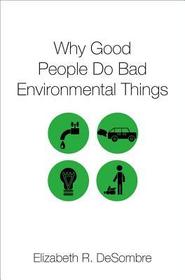
Why Good People Do Bad Environmental Things
- Publisher's listprice GBP 36.99
-
17 671 Ft (16 830 Ft + 5% VAT)
The price is estimated because at the time of ordering we do not know what conversion rates will apply to HUF / product currency when the book arrives. In case HUF is weaker, the price increases slightly, in case HUF is stronger, the price goes lower slightly.
- Discount 10% (cc. 1 767 Ft off)
- Discounted price 15 904 Ft (15 147 Ft + 5% VAT)
Subcribe now and take benefit of a favourable price.
Subscribe
17 671 Ft

Availability
printed on demand
Why don't you give exact delivery time?
Delivery time is estimated on our previous experiences. We give estimations only, because we order from outside Hungary, and the delivery time mainly depends on how quickly the publisher supplies the book. Faster or slower deliveries both happen, but we do our best to supply as quickly as possible.
Product details:
- Publisher OUP USA
- Date of Publication 28 June 2018
- ISBN 9780190636272
- Binding Hardback
- No. of pages264 pages
- Size 157x236x27 mm
- Weight 499 g
- Language English 0
Categories
Short description:
Why do people behave in ways that cause environmental harm? Despite not wanting to create environmental problems, we all do so regularly in the course of living our everyday lives. This book looks at how social structures, incentives, information, habits, attitudes, norms, and the inherent characteristics of environmental resources explain and influence how we behave, and how those causes influence what we can do to change behavior.
MoreLong description:
No one sets out to intentionally cause environmental problems. All things being equal, we are happy to protect environmental resources; in fact, we tend to prefer our air cleaner and our species protected. But despite not wanting to create environmental problems, we all do so regularly in the course of living our everyday lives. Why do we behave in ways that cause environmental harm?
It is often easy and inexpensive to behave in ways with bad environmental consequences, but more difficult and costly to take environmentally friendly actions. The incentives we face, some created by the nature of environmental resources, some by social and political structures, often do not make environmentally beneficial behavior the most likely choice. Furthermore, our behavior is conditioned by habits and social norms that fail to take environmental protection into consideration.
In this book, Elizabeth R. DeSombre integrates research from political science, sociology, psychology, and economics to understand why bad environmental behavior makes perfect sense. As she notes, there is little evidence that having more information about environmental problems or the way an individual's actions contribute to them changes behavior in meaningful ways, and lack of information is rarely the underlying cause that connects behavior to harm. In some cases such knowledge may even backfire, as people come to see themselves as powerless to address huge global problems and respond by pushing these issues out of their minds. The fact that causing environmental problems is never anyone's primary goal means that people are happy to stop causing them if the alternative behavior still accomplishes their underlying goals. If we can figure out why those problems are caused, when no one intends to cause them, we can develop strategies that work to shift behavior in a positive direction. Over the course of this book, DeSombre considers the role of structure, incentives, information, habit, and norms on behavior in order to formulate lessons about how these factors lead to environmentally problematic behavior, and what understanding their effects can tell us about ways to change behavior. To prevent or address environmental problems, we have to understand why even good people do bad environmental things.
This volume combines psychological, economic, and environmental approaches to offer a unique perspective on environmental policy. Addressing the widespread polarization over global climate change, DeSombre (Wellesley College) argues that nobody intends bad environmental effects...these and other themes are explored in a tightly organized book featuring factors such as social structures, extrinsic versus intrinsic factors, positive incentivization (e.g., subsidy), negative incentivization (e.g., regulation), attitudes, and scientific knowledge. Documented with 30 pages of notes and 26 pages of references, the book is an excellent resource for readers concerned about environmental policy.
Table of Contents:
Table of Contents
Acknowledgments
1. Why Good People Do Bad Environmental Things
2. Problem Characteristics
3. Incentives
4. Information
5. Habits and Other Routines
6. Attitudes and Norms
7. What to Do About It
Notes
Bibliography
Index

