

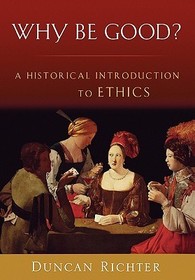
Why Be Good?
A Historical Introduction to Ethics
- Publisher's listprice GBP 31.99
-
14 443 Ft (13 755 Ft + 5% VAT)
The price is estimated because at the time of ordering we do not know what conversion rates will apply to HUF / product currency when the book arrives. In case HUF is weaker, the price increases slightly, in case HUF is stronger, the price goes lower slightly.
- Discount 10% (cc. 1 444 Ft off)
- Discounted price 12 998 Ft (12 380 Ft + 5% VAT)
Subcribe now and take benefit of a favourable price.
Subscribe
14 443 Ft

Availability
Uncertain availability. Please turn to our customer service.
Why don't you give exact delivery time?
Delivery time is estimated on our previous experiences. We give estimations only, because we order from outside Hungary, and the delivery time mainly depends on how quickly the publisher supplies the book. Faster or slower deliveries both happen, but we do our best to supply as quickly as possible.
Product details:
- Publisher OUP USA
- Date of Publication 6 December 2007
- ISBN 9780195325058
- Binding Paperback
- No. of pages224 pages
- Size 234x164x10 mm
- Weight 339 g
- Language English 0
Categories
Short description:
Why Be Good is an introduction to ethics whose guiding theme is the question posed by Thasymachus in Plato's Republic. Historically organized, the text presents a series of responses to the title question from Plato, Aristotle, thinkers in Christianity, Aquinas, Hobbes, Hume, Kant, Mill Nietzsche, and several twentieth century philosophers.
MoreLong description:
Why Be Good is an introduction to ethics whose guiding theme is the question posed by Thasymachus in Plato's Republic. Historically organized, the text presents a series of responses to the title question from Plato, Aristotle, thinkers in Christianity, Aquinas, Hobbes, Hume, Kant, Mill, Nietzsche, and several twentieth century philosophers. Duncan Richter explains each philosophers thoughts on ethics, virtue, and character and discusses ensuing
objections to each philosophers arguments. Along the way, students are encouraged to think about their own lives, what it meant to be good, and why or, rather, if they shoudl be good. Key terms appear for the first time in boldface, questions end each chapter, and suggestions for further reading are provided
throughout.
Table of Contents:
Acknowledgements
Introduction
Plato
Aristotle
Christianity
Aquinas
Hobbes
Hume
Kant
Mill
Nietzsche
Virtue after Nietzsche
Conclusion

