

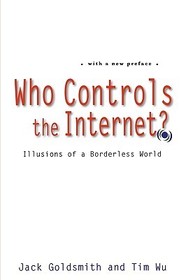
Who Controls the Internet?
Illusions of a Borderless World
- Publisher's listprice GBP 15.99
-
7 639 Ft (7 275 Ft + 5% VAT)
The price is estimated because at the time of ordering we do not know what conversion rates will apply to HUF / product currency when the book arrives. In case HUF is weaker, the price increases slightly, in case HUF is stronger, the price goes lower slightly.
- Discount 10% (cc. 764 Ft off)
- Discounted price 6 875 Ft (6 548 Ft + 5% VAT)
Subcribe now and take benefit of a favourable price.
Subscribe
7 639 Ft

Availability
printed on demand
Why don't you give exact delivery time?
Delivery time is estimated on our previous experiences. We give estimations only, because we order from outside Hungary, and the delivery time mainly depends on how quickly the publisher supplies the book. Faster or slower deliveries both happen, but we do our best to supply as quickly as possible.
Product details:
- Publisher OUP USA
- Date of Publication 17 July 2008
- ISBN 9780195340648
- Binding Paperback
- No. of pages240 pages
- Size 233x158x16 mm
- Weight 340 g
- Language English
- Illustrations halftones 0
Categories
Short description:
A critical look at the history and future of the Internet.
MoreLong description:
Is the Internet erasing national borders? Will the future of the Net be set by Internet engineers, rogue programmers, the United Nations, or powerful countries? Who's really in control of what's happening on the Net? In this provocative new book, Jack Goldsmith and Tim Wu tell the fascinating story of the Internet's challenge to governmental rule in the 1990s, and the ensuing battles with governments around the world. It's a book about the fate of one idea--that the Internet might liberate us forever from government, borders, and even our physical selves. We learn of Google's struggles with the French government and Yahoo's capitulation to the Chinese regime; of how the European Union sets privacy standards on the Net for the entire world; and of eBay's struggles with fraud and how it slowly learned to trust the FBI. In a decade of events the original vision is uprooted, as governments time and time again assert their power to direct the future of the Internet. The destiny of the Internet over the next decades, argue Goldsmith and Wu, will reflect the interests of powerful nations and the conflicts within and between them. While acknowledging the many attractions of the earliest visions of the Internet, the authors describe the new order, and speaking to both its surprising virtues and unavoidable vices. Far from destroying the Internet, the experience of the last decade has lead to a quiet rediscovery of some of the oldest functions and justifications for territorial government. While territorial governments have unavoidable problems, it has proven hard to replace what legitimacy governments have, and harder yet to replace the system of rule of law that controls the unchecked evils of anarchy. While the Net will change some of the ways that territorial states govern, it will not diminish the oldest and most fundamental roles of government and challenges of governance. Well written and filled with fascinating examples, including colorful portraits of many key players in Internet history, this is a work that is bound to stir heated debate in the cyberspace and globalization communities.
A timely look at the ways that governments make themselves felt in cyberspace. Goldsmith and Wu cover a range of controversies, from domain-name disputes to online poker and porn to political censorship. Their judgments are well worth attending.

