

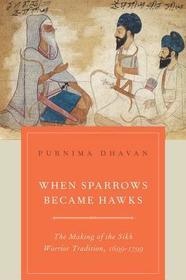
When Sparrows Became Hawks
The Making of the Sikh Warrior Tradition, 1699-1799
- Publisher's listprice GBP 122.50
-
55 308 Ft (52 675 Ft + 5% VAT)
The price is estimated because at the time of ordering we do not know what conversion rates will apply to HUF / product currency when the book arrives. In case HUF is weaker, the price increases slightly, in case HUF is stronger, the price goes lower slightly.
- Discount 10% (cc. 5 530 Ft off)
- Discounted price 49 778 Ft (47 408 Ft + 5% VAT)
Subcribe now and take benefit of a favourable price.
Subscribe
55 308 Ft

Availability
printed on demand
Why don't you give exact delivery time?
Delivery time is estimated on our previous experiences. We give estimations only, because we order from outside Hungary, and the delivery time mainly depends on how quickly the publisher supplies the book. Faster or slower deliveries both happen, but we do our best to supply as quickly as possible.
Product details:
- Publisher OUP USA
- Date of Publication 3 November 2011
- ISBN 9780199756551
- Binding Hardback
- No. of pages272 pages
- Size 236x163x25 mm
- Weight 544 g
- Language English 0
Categories
Short description:
Purnima Dhavan examines the creation of the Khalsa Sikh warrior tradition during the eighteenth century. By focusing on the experiences of long-overlooked peasant communities, she reveals how a dynamic process of debates, collaboration, and conflict transformed Sikh practices and shaped a new martial culture.
MoreLong description:
Challenging the commonly accepted belief that the distinctive rituals, ceremonies, and cultural practices associated with the Khalsa were formed during the lifetime of the Tenth and last Sikh Guru, Gobind Singh, Purnima Dhavan reveals how such markers of Khalsa identity evolved slowly over the course of the eighteenth century. By focusing on the long-overlooked experiences of peasant communities, she traces the multiple perspectives and debates that eventually coalesced to create a composite Khalsa culture by 1799.
When Sparrows Became Hawks incorporates and analyzes Sikh normative religious literature created during this period by reading it in the larger context of sources such as news reports, court histories, and other primary sources that show how actual practices were shaped in response to religious reforms. Recovering the agency of the peasants who dominated this community, Dhavan demonstrates how a dynamic process of debates, collaboration, and conflict among Sikh peasants, scholars, and chiefs transformed Sikh practices and shaped a new martial community.
Built on a close reading of Punjabi and Farsi sources, Purnima Dhavan's narrative of eighteenth-century Sikh history begins with Guru Gobind Singh and the inauguration of the Khalsa and goes on to examine three important but relatively little studied Sikh leaders of the period. This timely and readable book will be immensely helpful to anyone interested in this fascinating period of Sikh history.
Table of Contents:
1. Introduction: The Origins of the Khalsa
2. Early Narratives of the Last Guru and the Creation of the Khalsa
3. (Re)making the Khalsa, 1708-48
4. The Making of a Sikh Sardar: Two Jassa Singhs and the Place of Sikhs in the Eighteenth-Century Military Labor Market
5. Rereading Alha Singh: Rebel, Raja, and Sikh Sardar
6. From Peasant Soldier to Elite Warrior: Raiding, Honor Feuds, and the Transformation of Khalsa Identity
7. Devotion and Its Discontents: The Affective Communities of Gurbilas Texts
8. Conclusion
Glossary
Bibliography
Index

