

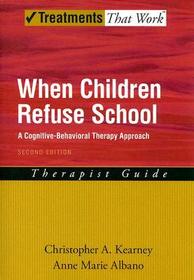
When Children Refuse School
A Cognitive-Behavioral Therapy Approach, Therapist Guide
Series: Treatments That Work;
- Publisher's listprice GBP 40.49
-
18 281 Ft (17 410 Ft + 5% VAT)
The price is estimated because at the time of ordering we do not know what conversion rates will apply to HUF / product currency when the book arrives. In case HUF is weaker, the price increases slightly, in case HUF is stronger, the price goes lower slightly.
- Discount 10% (cc. 1 829 Ft off)
- Discounted price 16 452 Ft (15 669 Ft + 5% VAT)
Subcribe now and take benefit of a favourable price.
Subscribe
18 281 Ft

Availability
Out of print
Why don't you give exact delivery time?
Delivery time is estimated on our previous experiences. We give estimations only, because we order from outside Hungary, and the delivery time mainly depends on how quickly the publisher supplies the book. Faster or slower deliveries both happen, but we do our best to supply as quickly as possible.
Product details:
- Edition number and title Therapist Guide
- Edition number 2
- Publisher OUP USA
- Date of Publication 5 April 2007
- ISBN 9780195308303
- Binding Paperback
- No. of pages288 pages
- Size 253x178x18 mm
- Weight 499 g
- Language English 0
Categories
Short description:
Many children and teenagers refuse to attend school or have anxiety-related difficulties that stop them from remaining in classes for an entire day. This Therapist Guide outlines a treatment based on CBT techniques for effectively treating school refusal behaviour.
MoreLong description:
Many children and teenagers refuse to attend school or have anxiety-related difficulties that stop them from remaining in classes for an entire day. School refusal behaviour can contribute to a child's academic, social and psychological problems, can impact upon their chances for future educational, financial and personal success, and can significantly affect family functioning.
This Therapist Guide outlines treatment protocols based on CBT techniques that can be used to effectively address the main types of school refusal behaviour. It concentrates on four primary reasons why children typically refuse school: to relieve school-related distress; to avoid negative social or evaluative situations at school; to receive attention from a parent or a significant other; and to obtain tangible rewards outside of school.
The guide includes tools for assessing a child's reasons for school refusal behaviour and presents well-tested techniques arranged by function to tailor treatment to a child's particular characteristics. Each treatment package also contains a detailed discussion of special topics pertinent to treating young people with school refusal behaviour, such as medication, panic attacks and being teased. A corresponding Workbook is available for parents, who often play an important part in a child's
recovery.
Table of Contents:
Introductory Information for Therapists
Assessment
Consultation Session and General Treatment Session Procedures
Children Refusing School to Avoid School-Related Stimuli That Provoke Negative Affectivity
Children Refusing School to Escape Aversive Social and/or Evaluative Situations
Children Refusing School for Attention
Children Refusing School for Tangible Rewards Outside of School
Slip and Relapse Prevention

