

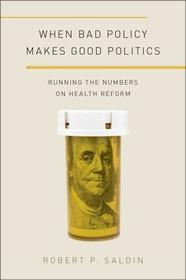
When Bad Policy Makes Good Politics
Running the Numbers on Health Reform
Series: Studies in Postwar American Political Development;
- Publisher's listprice GBP 40.99
-
19 582 Ft (18 650 Ft + 5% VAT)
The price is estimated because at the time of ordering we do not know what conversion rates will apply to HUF / product currency when the book arrives. In case HUF is weaker, the price increases slightly, in case HUF is stronger, the price goes lower slightly.
- Discount 10% (cc. 1 958 Ft off)
- Discounted price 17 624 Ft (16 785 Ft + 5% VAT)
Subcribe now and take benefit of a favourable price.
Subscribe
19 582 Ft

Availability
printed on demand
Why don't you give exact delivery time?
Delivery time is estimated on our previous experiences. We give estimations only, because we order from outside Hungary, and the delivery time mainly depends on how quickly the publisher supplies the book. Faster or slower deliveries both happen, but we do our best to supply as quickly as possible.
Product details:
- Publisher OUP USA
- Date of Publication 30 March 2017
- ISBN 9780190255442
- Binding Paperback
- No. of pages184 pages
- Size 234x152x12 mm
- Weight 272 g
- Language English 0
Categories
Short description:
Good government reforms instituted in the 1970s to thwart economically unsound legislation now cause chaos in America's policymaking process by incentivizing the development of flawed, even blatantly unworkable, policies. The CLASS Act and its role in passing President Obama's landmark health reform law illustrate the pathologies of the current system.
MoreLong description:
From all outward appearances, the American policymaking process has been revolutionized in the last half century. Beginning in the 1970s, new safeguards were put in place to prevent the kind of free-wheeling and sometimes reckless policymaking environment of earlier periods. These changes--including the creation of the non-partisan Congressional Budget Office--were widely hailed as ushering in a new era of accountability in Washington and putting an end to the days when cagey political operatives could rush major legislation through Congress without any real consideration of the economic costs. But what if the supposedly new and improved policymaking process that resulted from these 'good government' reforms is every bit as prone to manipulation as the one it replaced?
As Robert Saldin shows in When Bad Policy Makes Good Politics, that has unfortunately been the case. As in the past, the new politics of the policymaking process encourage savvy political actors to game the system. The very rules that were designed to thwart financially irresponsible legislation now incentivize the development of fundamentally flawed and unworkable policies. To uncover the pathologies of the American policymaking process, Saldin traces the sad tale of the Community Living Assistance Services and Supports (CLASS) Act. While few outside the beltway are aware of it, it was a major piece of legislation that played a central role in the passage of the Affordable Care Act (ACA), the most important social policy law since the 1960s. The CLASS Act targeted an intractable problem: the ever-increasing demand for costly long-term care services. For decades, both Republicans and Democrats have recognized the problem as a major one, so the question has not been whether we should tackle it. Rather, the debate centered on how we should do it-that is, how we should pay for it. The problem was always that the costs were staggering, and there was little political will to fund such a program (Medicare did not fund it). Long term care advocates realized this, and therefore focused on passing a law that effectively ignored the economic costs. They finally shuttled it into the larger Affordable Care Act, which was passed into law in 2010. Saldin traces the process, showing how an array of perverse incentives allowed such a flawed law to come into being. In fact, Kathleen Sibelius, the Secretary of Health and Human Services, announced in late 2011 that the administration would no longer try to put the law into effect because of its basic unworkability. Saldin's book is ostensibly about this one piece of legislation, but it's about much more than this: the near-impossibility of passing 'clean' laws that are not doctored by special interests adept at gaming the system. Essential reading for anyone interested in the policymaking process, the book establishes that our current policymaking environment produces outcomes that are just as perverse as the ones enacted by the old system.
Rob Saldin has written the kind of book that I wish I had authored, the kind that is an instant "classic" in the discipline.
Table of Contents:
Chapter 1: Introduction
Chapter 2: Washington's Old and New Systems of Policymaking
Chapter 3: A Legacy of Failure: Long-Term Care's Policy History and the Genesis of the
CLASS Act
Chapter 4: Learning from Failure: Only Bad Policy Stands a Chance
Chapter 5: CLASS on Capitol Hill, Part I: Dodging Committee Jurisdiction and the Number
Crunchers
Chapter 6: CLASS on Capitol Hill, Part II: A Bipartisan Backlash and the Missing "Fixes"
Chapter 7: Two Can Play at that Game
Chapter 8: Conclusion
Appendix

