

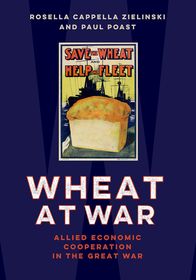
Wheat at War
Allied Economic Cooperation in the Great War
- Publisher's listprice GBP 19.99
-
9 025 Ft (8 595 Ft + 5% VAT)
The price is estimated because at the time of ordering we do not know what conversion rates will apply to HUF / product currency when the book arrives. In case HUF is weaker, the price increases slightly, in case HUF is stronger, the price goes lower slightly.
- Discount 10% (cc. 903 Ft off)
- Discounted price 8 122 Ft (7 736 Ft + 5% VAT)
Subcribe now and take benefit of a favourable price.
Subscribe
9 025 Ft

Availability
Estimated delivery time: In stock at the publisher, but not at Prospero's office. Delivery time approx. 3-5 weeks.
Not in stock at Prospero.
Why don't you give exact delivery time?
Delivery time is estimated on our previous experiences. We give estimations only, because we order from outside Hungary, and the delivery time mainly depends on how quickly the publisher supplies the book. Faster or slower deliveries both happen, but we do our best to supply as quickly as possible.
Product details:
- Publisher OUP USA
- Date of Publication 9 October 2025
- ISBN 9780197812747
- Binding Paperback
- No. of pages224 pages
- Size 232x156x16 mm
- Weight 268 g
- Language English 644
Categories
Short description:
Wheat at War explores how the Allies in the First World War created international institutions, such as the Wheat Executive, that were given the authority to make shipping and wheat distribution decisions on behalf of all the allies. As a case study, the Wheat Executive improves our understanding of international institutional design, the importance of commodities during wartime, economic coordination amongst wartime coalition members, and the legacies of international cooperation during the First World War.
MoreLong description:
The battlefields were not the only places that threatened death during World War I. As conflict raged on and supply lines tightened, the allied powers of France, Britain, and Italy faced a fundamental problem: keeping their soldier and civilian populations safe from starvation.
Wheat at War describes how, faced with this immense challenge, the Allies devised a multilateral institution--the Wheat Executive--to do what no state could do alone. Rosella Cappella Zielinski and Paul Poast examine the difficult considerations made by the allied powers when ceding authority to an international body that would make decisions for them. Beyond successfully managing wheat shipping and distribution, they argue, the Wheat Executive proved to have significant influence in the evolving landscape of interstate cooperation. As a case study, the Wheat Executive improves our understanding of international institutional design, the importance of commodities during wartime, economic coordination amongst wartime coalition members, and the legacies of international cooperation during the First World War. As one of the first great experiments in supranationalism, the Allies' management of wheat while at war provides lessons about the emergence of international organizations and their contours.
Table of Contents:
Preface
Chapter 1: Why Wheat and the First World War?
Chapter 2: Necessity and Willingness: A Guiding Framework
Chapter 3: Retaining Authority: The CIR and the Joint Committee
Chapter 4: Ceding Authority: The Wheat Executive
Chapter 5: Sharing Authority: The Allied Maritime Transport Council
Chapter 6: Reclaiming Authority: The Supreme Economic Council
Chapter 7: Conclusions and Implications
Bibliography
Index
List of Figures
List of Tables
Why Wheat and the First World War?
Necessity and Willingness: A Guiding Framework
Retaining Authority: The CIR and the Joint Committee
Ceding Authority: The Wheat Executive
Sharing Authority: The Allied Maritime Transport Council
Reclaiming Authority: The Supreme Economic Council
Wheat During the Great War: Legacy and Implications
Bibliography
Index

