

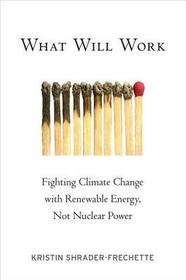
What Will Work
Fighting Climate Change with Renewable Energy, Not Nuclear Power
Series: Environmental Ethics and Science Policy Series;
- Publisher's listprice GBP 33.49
-
15 120 Ft (14 400 Ft + 5% VAT)
The price is estimated because at the time of ordering we do not know what conversion rates will apply to HUF / product currency when the book arrives. In case HUF is weaker, the price increases slightly, in case HUF is stronger, the price goes lower slightly.
- Discount 10% (cc. 1 512 Ft off)
- Discounted price 13 608 Ft (12 960 Ft + 5% VAT)
Subcribe now and take benefit of a favourable price.
Subscribe
15 120 Ft

Availability
printed on demand
Why don't you give exact delivery time?
Delivery time is estimated on our previous experiences. We give estimations only, because we order from outside Hungary, and the delivery time mainly depends on how quickly the publisher supplies the book. Faster or slower deliveries both happen, but we do our best to supply as quickly as possible.
Product details:
- Publisher OUP USA
- Date of Publication 6 November 2014
- ISBN 9780190215187
- Binding Paperback
- No. of pages368 pages
- Size 156x234x20 mm
- Weight 562 g
- Language English 0
Categories
Short description:
What Will Work makes a rigorous and compelling case that energy efficiencies and renewable energy -- and not nuclear fission or "clean coal"-- are the most effective, cheapest, and equitable solutions to the pressing problem of climate change.
MoreLong description:
What Will Work makes a rigorous and compelling case that energy efficiencies and renewable energy -- and not nuclear fission or "clean coal" -- are the most effective, cheapest, and equitable solutions to the pressing problem of climate change.
Kristin Shrader-Frechette, a respected environmental ethicist and scientist, makes a damning case that the only reason that debate about climate change continues is because fossil-fuel interests pay non-experts to confuse the public. She then builds a comprehensive case against the argument made by many that nuclear fission is a viable solution to the problem, arguing that data on the viability of nuclear power has been misrepresented by the nuclear industry and its supporters. In particular she says that they present deeply flawed cases that nuclear produces low greenhouse gas emissions, that it is financially responsible, that it is safe, and that its risks do not fall mainly on the poor and vulnerable. She argues convincingly that these are all completely false assumptions.
Shrader-Frechette then shows that energy efficiency and renewable solutions meet all these requirements - in particular affordability, safety, and equitability. In the end, the cheapest, lowest-carbon, most-sustainable energy solutions also happen to be the most ethical.
This urgent book on the most pressing issue of our time will be of interest to anyone involved in environmental and energy policy.
Table of Contents:
Glossary
Chapter 1: Why Climate-Change Skeptics Are Wrong
Chapter 2: Trimming the Data on Nuclear Greenhouse Emissions
Chapter 3: Trimming the Data on Nuclear Costs
Chapter 4: Nuclear Safety, Flawed Science, and Accident Cover-Up
Chapter 5: Nuclear Energy and Environmental Justice
Chapter 6: The Solution:
Using Renewable Energy, Efficiency, and Conservation to Address Climate Change
Chapter 7: Answering Objections
Chapter 8: Conclusions
Notes

