

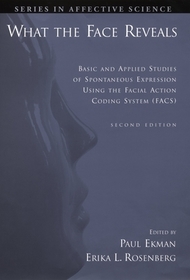
What the Face Reveals
Basic and Applied Studies of Spontaneous Expression Using the Facial Action Coding System (FACS)
Series: Series in Affective Science;
- Publisher's listprice GBP 85.00
-
40 608 Ft (38 675 Ft + 5% VAT)
The price is estimated because at the time of ordering we do not know what conversion rates will apply to HUF / product currency when the book arrives. In case HUF is weaker, the price increases slightly, in case HUF is stronger, the price goes lower slightly.
- Discount 10% (cc. 4 061 Ft off)
- Discounted price 36 548 Ft (34 808 Ft + 5% VAT)
Subcribe now and take benefit of a favourable price.
Subscribe
40 608 Ft

Availability
printed on demand
Why don't you give exact delivery time?
Delivery time is estimated on our previous experiences. We give estimations only, because we order from outside Hungary, and the delivery time mainly depends on how quickly the publisher supplies the book. Faster or slower deliveries both happen, but we do our best to supply as quickly as possible.
Product details:
- Edition number 2
- Publisher OUP USA
- Date of Publication 12 May 2005
- ISBN 9780195179644
- Binding Hardback
- No. of pages672 pages
- Size 243x167x35 mm
- Weight 1075 g
- Language English
- Illustrations 31 halftones, 30 line illus. 0
Categories
Short description:
The chapters in this volume represent the state-of-the-art in the study of facial expression. They address key topics and questions such as the dynamic and morphological differences between voluntary expressions, the relationship between what people show on their faces and what they say they feel, whether it is possible to use facial behavior to draw distinctions among psychiatric populations, and the latest research on automating facial measurement. The book also includes updated
commentary by the authors on any contributions appearing previously and a concluding integration and critique of all the contributions by Paul Ekman. As an essential reference for all those working in the area of facial analysis and expression, this volume will be indispensable for a wide range of
professionals and students in the fields of psychology, psychiatry, and behavioral medicine.
Long description:
While we have known for centuries that facial expressions can reveal what people are thinking and feeling, it is only recently that the face has been studied scientifically for what it can tell us about internal states, social behavior, and psychopathology. Today's widely available, sophisticated measuring systems have allowed us to conduct a wealth of new research on facial behavior that has contributed enormously to our understanding of the relationship between facial expression and human psychology. The chapters in this volume present the state-of-the-art in this research. They address key topics and questions, such as the dynamic and morphological differences between voluntary and involuntary expressions, the relationship between what people show on their faces and what they say they feel, whether it is possible to use facial behavior to draw distinctions among psychiatric populations, and how far research on automating facial measurement has progressed. The book also includes follow-up commentary on all of the original research presented and a concluding integration and critique of all the contributions made by Paul Ekman.
As an essential reference for all those working in the area of facial analysis and expression, this volume will be indispensable for a wide range of professionals and students in the fields of psychology, psychiatry, and behavioral medicine.
What the Face Reveals dramatically illustrates the value of precise measurement of facial behavior in illuminating an impressive range of issues in basic and applied research. The chapters present innovative state-of-the-art applications of facial measurement, and the commentaries by authors and editors greatly enrich the readers experience. This is affective science of the highest quality, brimming with intriguing findings and promising new directions.
Table of Contents:
Basic Research Emotion
Is the Startle Reaction an Emotion?
Afterword: Is the Startle Reaction an Emotion?
The Asymmetry of Facial Actions is Inconsistent with Models of Hemispheric Specialization
Afterword: Asymmetry in Facial Muscular Actions
Coherence Between Expressive and Experiential Systems in Emotion
Afterword: Erika Rosenberg
Will the Real Relationship between Facial Expression and Affective Experience Please Stand Up: The Case of Exhilaration
Afterword: The FACS in Humor Research
Extroversion, Alcholo, and Enjoyment
Afterword: Laughter and Temperament
Signs of Appeasement: Evidence for the Distinct Displays of Embarrassment, Amusement, and Shame
Genuine, Suppressed, and Faked Facial Behavior During Exacerbation of Chronic Low Back Pain
Afterword: On Knowing Another's Pain
The Consistency of Facial Expressions of Pain: A Comparison Across Modalities
Afterword: The Consistency of Facial Expressions of Pain
Smiles When Lying
Afterword: Smiles When Lying
Behavioral Markers and Recognizability of the Smile of Enjoyment
Afterword: Some Thoughts on FACS. Dynamic Markers of Emotion and Baseball
Components and Recognition of Facial Expression in the Communications of Emotion by Actors
Afterword: Components and Recognition of Facial Expressions in the Communication of Emotion by Actors Gilles Kirouac
Differentiating Emotiom Elicited and Deliberate Emotional Facial Expression
Afterword: Ursula Hess
Japanese and American Infants' Responses to Arm Restraint
Differential Facial Responses to Four Basic Tastes in Newborns
Afterword: Facial Expressions as a Window on Sensory Experience and Affect in Newborn Infants
All Smiles are Positive, But Some Smiles are More Positive than Others
Afterword: A Measure of Early Joy
Signal Characteristics of Spontaneous Facial Expression: Automatic Movement in Solitary and Social Smiles
Automated Face Analysis by Feature Point Tracking has High Concurrent Validity with Manual FACS Coding
Towards Automatic Recognition of Spontaneous Facial Actions
Applied Research
Facial Expression in Affective Disorders
Emotional Experience and Expression in Schizophrenia and Depression
Interaction Regulations Used by Schizophrenic and Psychosomatic Patients; Studies on Facial Behavior in Dyadic Interactions
Afterword: Rainer Krause
Nonverbal Expression of Psychological States in Psychiatric Patients
Afterword: Nonverbal Expression of Psychological States in Psychiatric Patients
Depression and Suicide Faces
Afterword: Perspectives for Studies for Psychopathology and Psychotherapy
Prototypical Affective Microsequences in Psychotherapeutic Interactions
Afterword: From PAMS to TRAPS: Investigating Guilt Feelings with FACS
Facial Expressions of Emotion and Psychopathology in Adolescent Boys
Afterword: Facial Expression, Personality, and Psychopathology
Type A Behavior Pattern: Facial Behavior and Speech Components
Afterword: Paul Ekman, Erika L. Rosenberg, Margaret Chesney
Linkages between Facial Expressions of Anger and Transient Myocardial Ischemia in Men with Coronary Artery Disease
Afterword: Erika L. Rosenberg and Paul Ekman
Effects of Smoking Opportunity on Cue-Elicited Urge: A Facial Coding Analysis
Afterword: Using FACS to Identify Contextual Factors Influencing Craving
Conclusion: What We Have Learned by Measuring Facial Behavior

