

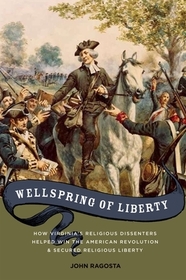
Wellspring of Liberty
How Virginia's Religious Dissenters Helped Win the American Revolution and Secured Religious Liberty
- Publisher's listprice GBP 49.99
-
23 882 Ft (22 745 Ft + 5% VAT)
The price is estimated because at the time of ordering we do not know what conversion rates will apply to HUF / product currency when the book arrives. In case HUF is weaker, the price increases slightly, in case HUF is stronger, the price goes lower slightly.
- Discount 10% (cc. 2 388 Ft off)
- Discounted price 21 494 Ft (20 471 Ft + 5% VAT)
Subcribe now and take benefit of a favourable price.
Subscribe
23 882 Ft

Availability
printed on demand
Why don't you give exact delivery time?
Delivery time is estimated on our previous experiences. We give estimations only, because we order from outside Hungary, and the delivery time mainly depends on how quickly the publisher supplies the book. Faster or slower deliveries both happen, but we do our best to supply as quickly as possible.
Product details:
- Publisher OUP USA
- Date of Publication 3 June 2010
- ISBN 9780195388060
- Binding Hardback
- No. of pages272 pages
- Size 241x159x23 mm
- Weight 517 g
- Language English 0
Categories
Short description:
Virginia's dissenters, primarily Presbyterians and Baptists, demanded religious liberty in return for supporting the American Revolution. The resulting negotiations not only brought Virginia, and America, religious freedom, but politicized dissenters and republicanized the polity. Importantly, dissenters demanded strict separation of church and state, rejecting the notion of a "Christian nation."
MoreLong description:
Before the American Revolution, no state more seriously discriminated against and persecuted religious dissenters than Virginia. Over 50 dissenting ministers, primarily Baptists, were jailed, and numerous Baptists and Presbyterians were beaten or harassed. African-American congregants were treated particularly viciously. By the time the U.S. Constitution was adopted, no state provided more extensive protection to religious freedom, nor did so in terms nearly so elegant as Thomas Jefferson's Statute for Establishing Religious Freedom. This dramatic change occurred because Virginia's dissenters, constituting as much as one-third or more of the population, demanded religious freedom before they would mobilize for the American Revolution; Virginia's establishment leaders, the same gentry leaders who led much of the persecution, had little choice but to grant that freedom. In return, dissenting ministers played an important role both in encouraging enlistments during the Revolution and themselves joining in the fighting. By comparison, British efforts to co-opt religious dissent were wan and failed to gain significant support in Virginia.
By the end of the war, though, religious liberty was not yet complete, and with the necessity of mobilization eliminated, establishment leaders, led by Patrick Henry, sought to reinvigorate the formerly established church through a general tax to benefit all Christian denominations. This proved too much for the dissenters who had demanded religious freedom based on both their politics and theology; politicized by the negotiations during the Revolution and with James Madison coordinating legislative efforts, they rose up to quash the idea of a religious tax and insisted upon adoption of Jefferson's Statute. In doing so, these eighteenth century evangelicals demanded a strict separation of church and state. The impact of their joining the polity and the robust religious liberty which they left as a legacy still resonate today.
A superb telling of an inadequately explored part of the revolution in Virginia. Wellspring of Liberty deserves to take a prominent place on the shelf of religious and social history during the American Revolution.
Table of Contents:
Introduction
Virginians Dissent: Snakes, Hornets, and Brimstone
Negotiating Support for the War and Religious Freedom
British Failures and Plans for Success
Mobilizing Support: Did the Dissenters Fight?
After the War: A Resurgent Establishment and the End of Compulsion
What Did They Fight, and Bargain, For?
Epilogue
Notes
Bibliography
Index

