

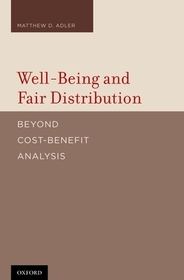
Well-Being and Fair Distribution
Beyond Cost-Benefit Analysis
- Publisher's listprice GBP 140.00
-
63 210 Ft (60 200 Ft + 5% VAT)
The price is estimated because at the time of ordering we do not know what conversion rates will apply to HUF / product currency when the book arrives. In case HUF is weaker, the price increases slightly, in case HUF is stronger, the price goes lower slightly.
- Discount 10% (cc. 6 321 Ft off)
- Discounted price 56 889 Ft (54 180 Ft + 5% VAT)
Subcribe now and take benefit of a favourable price.
Subscribe
63 210 Ft

Availability
printed on demand
Why don't you give exact delivery time?
Delivery time is estimated on our previous experiences. We give estimations only, because we order from outside Hungary, and the delivery time mainly depends on how quickly the publisher supplies the book. Faster or slower deliveries both happen, but we do our best to supply as quickly as possible.
Product details:
- Publisher OUP USA
- Date of Publication 15 December 2011
- ISBN 9780195384994
- Binding Hardback
- No. of pages656 pages
- Size 165x236x38 mm
- Weight 1083 g
- Language English 0
Categories
Short description:
In Well-Being and Fair Distribution: Beyond Cost-Benefit Analysis, author Matthew D. Adler provides readers with a comprehensive philosophically grounded argument for the use of social welfare functions as a framework for governmental policy analysis.
MoreLong description:
In Well-Being and Fair Distribution: Beyond Cost-Benefit Analysis, author Matthew D. Adler provides readers with a comprehensive philosophically grounded argument for the use of social welfare functions as a framework for governmental policy analysis.
Well-Being and Fair Distribution addresses a range of relevant theoretical issues, including the possibility of an interpersonally comparable measure of well-being, or "utility" metric; the moral value of equality, and how that bears on the form of the social welfare function; social choice under uncertainty; and the possibility of integrating considerations of individual choice and responsibility into the social-welfare-function framework. Adler's book also deals with issues of implementation, and explores how survey data and other sources of evidence might be used to calibrate both a utility metric and a social welfare function, and whether distributive goals are ever best pursued through regulation rather than the tax system. In working through this range of theoretical and practical issues, Well-Being and Fair Distribution draws from a wide variety of literatures, including philosophical scholarship on equality, responsibility, the nature of well-being, and personal identity over time; the social choice literature within economics; applied economic literatures concerning the measurement of inequality and poverty; legal and policy-analysis scholarship on cost-benefit analysis, environmental justice, and the choice between regulation and taxation; and the burgeoning field of "happiness studies."
... a new and refreshing take on the subject of fair distribution... an invaluable contribution to an ongoing dialogue that is critically important to sustain and nourish.
Table of Contents:
Introduction
Chapter 1. Preliminaries: Morality, Consequentialism, Welfarism
Chapter 2. The SWF Approach and its Competitors
Chapter 3. Well-Being and Interpersonal Comparisons
Chapter 4. Estimating Utilities
Chapter 5. The Case for a Continuous Prioritarian SWF
Chapter 6. Lifetime Prioritarianism
Chapter 7. Ranking Actions: Prioritarianism under Uncertainty
Chapter 8. Next Steps

