

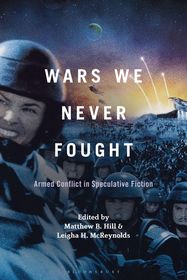
Wars We Never Fought
Armed Conflict in Speculative Fiction
-
GET 18% OFF
- Publisher's listprice GBP 95.00
-
45 386 Ft (43 225 Ft + 5% VAT)
The price is estimated because at the time of ordering we do not know what conversion rates will apply to HUF / product currency when the book arrives. In case HUF is weaker, the price increases slightly, in case HUF is stronger, the price goes lower slightly.
- Discount 18% (cc. 8 169 Ft off)
- Discounted price 37 217 Ft (35 445 Ft + 5% VAT)
- Discount is valid until: 31 March 2026
37 217 Ft

Availability
printed on demand
Why don't you give exact delivery time?
Delivery time is estimated on our previous experiences. We give estimations only, because we order from outside Hungary, and the delivery time mainly depends on how quickly the publisher supplies the book. Faster or slower deliveries both happen, but we do our best to supply as quickly as possible.
Product details:
- Publisher Bloomsbury Publishing (UK)
- Date of Publication 11 December 2025
- Number of Volumes Hardback
- ISBN 9798765121535
- Binding Hardback
- No. of pages320 pages
- Size 232x160x24 mm
- Weight 600 g
- Language English
- Illustrations 5 b&w illustrations 678
Categories
Short description:
A collection of 16 essays examining how armed conflict functions as a subject, theme, metaphor, symbol, or plot device in works of science fiction, fantasy, and other speculative fictions.
MoreLong description:
"
A collection of essays examining how armed conflict functions as a subject, theme, metaphor, symbol, or plot device in popular works of speculative fiction, including novels, films, television, and video games.
Speculative fiction - genres such as science fiction, fantasy, utopian/dystopian, apocalyptic/post-apocalyptic, supernatural, horror, superhero, and alternative history - is, at this particular cultural moment, incontrovertibly popular. Despite the fact that war and its social, cultural, political, and moral consequences are often a driving force in speculative fiction narratives, exerting outsized influence on character development, structuring plot and conflict, and serving as a vehicle to explore various themes, there has been little critical attention given specifically to the intersection of these concepts.
Wars We Never Fought remedies this problem, as contributors analyze such popular texts as the Star Wars franchise, Ann Leckie's Imperial Radch trilogy, Dune, Mary Doria Russell's The Sparrow and Children of God, The Expanse series, Captain Marvel, and the Fallout game franchise. These essays offer accessible and wide-ranging critical insight into how and why creators of speculative fiction use war as a device within the diegetic worlds of their stories. They also look at what the depictions of war and warriors within these texts suggest regarding notions such as race, class, gender, sexuality, difference, sociopolitical power, and other cultural values.
Contextualizing the culture in which these narratives are created and consumed, Wars We Never Fought demonstrates how the textual dramatization of entirely fictitious wars might reflect, interrogate, and even structure understanding of warfare in the ""real world.""
Table of Contents:
"
List of Figures
Acknowledgments
Introduction: The Narrative Functions of Armed Conflict in Speculative Fiction
Matthew B. Hill, Coppin State University, USA & Leigha H. McReynolds, University of Maryland College Park, USA
Part 1: Imagining History
1. ""Preview of the War We Do Not Want"": Optimistic Apocalypse in the Early Cold War
Mike Davis, Lees-McRae College, USA
2. Unite the Right: Recruiting and Coalition Building in Patriot Militia Fiction
Johann Pautz, Florida State College at Jacksonville, USA
Part 2: War and Space Opera
3. Just ""simple men making their way through the galaxy""? Frontier Identities and Liminal Spaces in The Mandalorian and The Book of Boba Fett
John Quinn and Colin Atkinson, University of West Scotland, UK
4. ""I am as she made me"": Ancillary Atrocities in Leckie's Imperial Radch Trilogy
Ryan Morrison, Flinders University, Australia
5. The Future's Wounds: Exploring the Moral Injury in Ann Leckie's Ancillary Trilogy
Halilcan Sap, Istanbul Dogus University, Turkey
Part 3: War and Social Crises
6. Tyranny and Terraforming: Exploring Oppression, Peace, and Ecological Dynamics in the Dune Saga
Willow Wilson DiPasquale, Philadelphia University & Thomas Jefferson University, USA
7. Traitors of the Apocalypse: The Demon Ascendant Trope in Film and Television
Matthew Konerth, University of Denver & School of Illiff, USA
8. The Politics of Knowing, Depicting, and Conducting War in The Sparrow and Children of God
Jakub Zï¿1⁄2hora, University of New York in Prague, Czechia, and Katarina Kusic, University of Bremen, Germany
Part 4: War and Gender
9. The Posthuman Patriarchal Villain as Absolute Military Threat: Winston Duarte in The Expanse Novel Series
Sara Martï¿1⁄2n, Universitat Autï¿1⁄2noma de Barcelona, Spain
10. Gender and the Work of War in Captain Marvel and The Marvels
Erin Casey-Williams, Nichols College, USA
11. Never Stop Fighting: Portrayals of Female War Veterans in Video Games
Ragnhild Solberg, Norwegian University of Science and Technology, Norway
12. Gender Essentialist Zombies and Trans Survival: Apocalyptic Conflict in Manhunt
Sarah Nolan-Brueck, University of Southern California, USA
Part 5: Wargames, Nation, and Community
13. ""Secession from Sodom Below"": Bioshock Infinite's Civil War over National and Individual Identity
Justin Cosner, University of Iowa, USA
14. Life After War in The Quiet Year
Tim Bryant, SUNY Buffalo State University, USA
15. No War But the Class War: Ranciï¿1⁄2re, International Relations, Class Conflict, and the Total War Franchise
Guillaume Lacombe-Kishibe, University of Ottawa, Canada
Contributors
Index

