

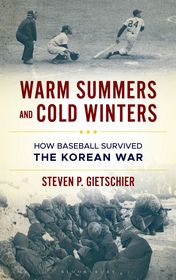
Warm Summers and Cold Winters
How Baseball Survived the Korean War
- Publisher's listprice GBP 25.99
-
11 734 Ft (11 175 Ft + 5% VAT)
The price is estimated because at the time of ordering we do not know what conversion rates will apply to HUF / product currency when the book arrives. In case HUF is weaker, the price increases slightly, in case HUF is stronger, the price goes lower slightly.
- Discount 20% (cc. 2 347 Ft off)
- Discounted price 9 387 Ft (8 940 Ft + 5% VAT)
- Discount is valid until: 30 June 2026
Subcribe now and take benefit of a favourable price.
Subscribe
11 734 Ft

Availability
Not yet published.
Why don't you give exact delivery time?
Delivery time is estimated on our previous experiences. We give estimations only, because we order from outside Hungary, and the delivery time mainly depends on how quickly the publisher supplies the book. Faster or slower deliveries both happen, but we do our best to supply as quickly as possible.
Product details:
- Publisher Bloomsbury Publishing (UK)
- Date of Publication 25 June 2026
- ISBN 9781538193884
- Binding Hardback
- No. of pages288 pages
- Size 230x156x24 mm
- Weight 540 g
- Language English
- Illustrations 20 b/w photos; 700
Categories
Short description:
"This book provides a fascinating examination of four baseball seasons set against the backdrop of the Korean War, the ""forgotten war"" whose impact on the United States-and baseball-remains underappreciated."
MoreLong description:
"
A fascinating examination of the Korean War years and its impact on Major League Baseball
Although baseball's history in the immediate post-World War II years has sometimes been characterized as a ""golden age,"" such was not the case. By the time North Korean troops crossed the 38th parallel in June 1950, Organized Baseball was still struggling to re-integrate returning veterans into its labor force, fight off an attempt at unionization, and deal with a competing major league south of the border.
In Warm Summers and Cold Winters, historian Steven P. Gietschier carefully examines four baseball seasons-1950, 1951, 1952, and 1953-set against the background of Cold War America and the Korean War, a ""forgotten war"" that is often overlooked and underappreciated for its impact on US and baseball history. These four seasons saw exciting pennant races, the success of the Philadelphia Phillies' Whiz Kids in 1950; the ""shot heard 'round the world"" in 1951; the debuts of Willie Mays and Mickey Mantle; and the tenure of Bill Veeck as owner of the St. Louis Browns. On the warfront, the hostilities in Korea stand as the first time the United States tried to fight a war with one hand tied behind its back, attempting to fight a limited war without disrupting civilian life. Simultaneously, the United States' limited military commitment meant that the war imposed peculiar challenges and uneven pressures upon individuals and institutions throughout American society, including Organized Baseball.
Providing rare insight into how baseball responded to the unique situation the country found itself in during the Korean War years, Warm Summers and Cold Winters will be of interest to baseball and military historians alike.
Table of Contents:
"
Acknowledgements
Prologue: Cold War in Europe, Oct-Dec 1949
Chapter 1: Cold War in Asia, Jan-Mar 1950
Chapter 2: A Divided Korea, Apr-Jun 1950
Chapter 3: The Police Action and the Pennant Race, Jul-Sep 1950
Chapter 4: The Whiz Kids Come Up Short, Oct-Dec 1950
Chapter 5: Facing Manpower Shortages, Jan-Mar 1951
Chapter 6: Truman Fires MacArthur, Apr-Jun 1951
Chapter 7: Frick Replaces Chandler, Jul-Sep 1951
Chapter 8: ""The Giants Win the Pennant!"" Oct-Dec 1951
Chapter 9: Salaries, Ticket Prices, and Integration, Jan-Mar 1952
Chapter 10: Steelworkers on Strike, Apr-Jun 1952
Chapter 11: ""We Want Ike,"" Jul-Sep 1952
Chapter 12: Four Straight for the Yankees, Oct-Dec 1952
Chapter 13: The Braves Move to Milwaukee, Jan-Mar 1953
Chapter 14: The ""Game of the Week,"" Apr-Jun 1953
Epilogue: Armistice at Last, Jul-Sep 1953
Notes
Bibliography
Index
About the Author

