

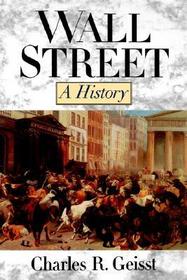
Wall Street
A History
- Publisher's listprice GBP 32.99
-
14 894 Ft (14 185 Ft + 5% VAT)
The price is estimated because at the time of ordering we do not know what conversion rates will apply to HUF / product currency when the book arrives. In case HUF is weaker, the price increases slightly, in case HUF is stronger, the price goes lower slightly.
- Discount 10% (cc. 1 489 Ft off)
- Discounted price 13 405 Ft (12 767 Ft + 5% VAT)
Subcribe now and take benefit of a favourable price.
Subscribe
14 894 Ft

Availability
Out of print
Why don't you give exact delivery time?
Delivery time is estimated on our previous experiences. We give estimations only, because we order from outside Hungary, and the delivery time mainly depends on how quickly the publisher supplies the book. Faster or slower deliveries both happen, but we do our best to supply as quickly as possible.
Product details:
- Publisher Oxford University Press
- Date of Publication 15 January 1998
- ISBN 9780195115123
- Binding Hardback
- No. of pages416 pages
- Size 245x166x32 mm
- Weight 741 g
- Language English
- Illustrations halftones 0
Categories
Short description:
Wall Street is the stuff of legend and a source of nightmares, a force so powerful in American society -- and, indeed, in international business and culture -- that it has become an almost universal symbol of both the highest aspirations of commercial success and the basest impulses of greed and deception. How did such a small, concentrated pocket of lower Manhattan came to have such enormous influence in national and world affairs?
In this wide-ranging volume, economic historian Charles Geisst answers this question as he provides the first history of Wall Street -- ranging from the loose association of traders meeting on New York sidewalks and coffee houses in the late 18th century, to the modern billion-dollar computer-driven colossus of today. Taking in the Gold Rush and the economic boom (for the North) of the Civil War, the great stock market crash of 1929, and the junk bond frenzy and the merger mania of the 1980s,
this is a tale of profits and losses, enterprising spirits and colourful personalities, and the role Wall Street played in helping America become the most powerful economy in the world.
Long description:
Wall Street is the stuff of legend and a source of nightmares, a force so powerful in American society--and, indeed, in world economics and culture--that it has become an almost universal symbol of both the highest aspirations of commercial success and the basest impulses of greed and deception. How did such a small, concentrated pocket of lower Manhattan came to have such enormous influence in national and world affairs. In this wide-ranging volume, economic historian Charles
Geisst answers this question as he provides the first history of Wall Street, ranging from the loose association of traders meeting on New York sidewalks and coffee houses in the late 18th century, to the modern billion-dollar computer-driven colossus of today.
Here is a fascinating chronicle of America's securities industry and of its role in our nation's economic development. Geisst's narrative ranges over two centuries, from just after the Revolutionary War, to the California Gold Rush and the economic boom (for the North) of the Civil War, to the great stock market crash of 1929, right up to the recent junk bond frenzy and the merger mania of the 1980s that culminated in the fall of Drexel Burnham. The book traces many themes--the move of industry
and business westward in the early 19th century, the rise of the great Robber Barons, the influence of the securities market on incredible growth of industry, particularly in the innovative financing of the railroads and major steel companies and crucial investments in Bell's and Edison's technical
innovations. Geisst also looks at the gradual increase in government involvement in Wall Street, revealing how regulation had been minimal at first and many investors had suffered from the abuses of corrupt firms. But with the beginning of the New Deal, the government stepped in to pass a series of laws--centered on the Securities Exchange Commission--that severely restricted the ways that Wall Street firms could operate. Here began a heated debate that still rages today between those who want
unfettered license to operate as they please and those who want the government to regulate the market to curb corruption. Of course, "The Street" has always been a breeding ground for characters with brazen nerve, and no history of the stock market would be complete without a look at the most
ruthless wheeler dealers. Geisst for instance details the manipulations by which Jay Gould and associates cornered the gold market, leading to the terrifying market crash on "Black Friday" in September 1869. Here too are battles of will between powerful personalities and the determined rise to power of such "self made men" as John Jacob Astor, John D. Rockefeller, and Cornelius "Commodore" Vanderbilt--as well as the connivings of lesser known deal makers like William Crapo "Billy" Durant,
reputed to have made $50 million in three months shortly before the stock market crash in 1929.
Wall Street is at once a chronicle of the street itself, from the days when the wall was merely a defensive barricade built by Peter Stuyvesant, and in a broader sense it is an engaging economic history of the United States, a tale of profits and losses, endlessly enterprising spirits, and the role Wall Street played in helping America become the most powerful economy in the world.
A sweeping, inclusive account of 200 years of "the Street's" colourful past and its inextricable influence on America
Table of Contents:
The Early Years (1790-1840)
The Railroad and Civil War Eras (1840-1870)
The Robber Barons (1870-1890)
The Age of the Trusts (1880-1910)
The Money Trust (1890-1920)
The Booming '20s (1920-1929)
Wall Street Meets the New Deal (1930-1935)
The Struggle Continues (1936-1954)
Bull Market (1954-1969)
Bear Market (1970-1981)
Mergermania (1982-1995)
Bibliography

