

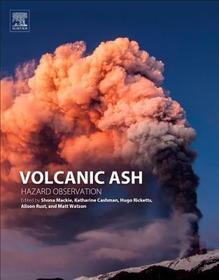
Volcanic Ash
Hazard Observation
- Publisher's listprice EUR 118.00
-
48 940 Ft (46 610 Ft + 5% VAT)
The price is estimated because at the time of ordering we do not know what conversion rates will apply to HUF / product currency when the book arrives. In case HUF is weaker, the price increases slightly, in case HUF is stronger, the price goes lower slightly.
- Discount 10% (cc. 4 894 Ft off)
- Discounted price 44 046 Ft (41 949 Ft + 5% VAT)
Subcribe now and take benefit of a favourable price.
Subscribe
48 940 Ft

Availability
printed on demand
Why don't you give exact delivery time?
Delivery time is estimated on our previous experiences. We give estimations only, because we order from outside Hungary, and the delivery time mainly depends on how quickly the publisher supplies the book. Faster or slower deliveries both happen, but we do our best to supply as quickly as possible.
Product details:
- Publisher Elsevier Science
- Date of Publication 27 May 2016
- ISBN 9780081004050
- Binding Paperback
- No. of pages300 pages
- Size 276x215 mm
- Weight 840 g
- Language English 0
Categories
Long description:
Volcanic Ash: Hazard Observation presents an introduction followed by four sections, each on a separate topic and each containing chapters from an internationally renowned pool of authors. The introduction provides a volcanological context for ash generation that sets the stage for the development and interpretation of techniques presented in subsequent sections.
The book begins with an examination of the methods to characterize ash deposits on the ground, as ash deposits on the ground have generally experienced some atmospheric transport. This section will also cover basic information on ash morphology, density, and refractive index, all parameters required to understand and analyze assumptions made for both in situ measurements and remote sensing ash inversion techniques. Sections two, three, and four focus on methods for observing volcanic ash in the atmosphere using ground-based, airborne, and spaceborne instruments respectively.
Throughout the book, the editors showcase not only the interdisciplinary nature of the volcanic ash problem, but also the challenges and rewards of interdisciplinary endeavors. Additionally, by bringing together a broad perspective on volcanic ash studies, the book not only ties together ground-, air-, academic, and applied approaches to the volcanic ash problem, but also engages with other scientific communities interested in particulate transport.
MoreTable of Contents:
Processes for ash generation
Observations of ash on the ground
Observing airborne ash from the ground
Observing airborne ash from aircraft
Observing airborne ash from space

