

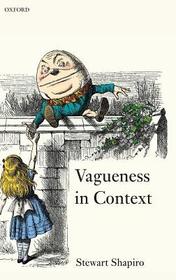
Vagueness in Context
- Publisher's listprice GBP 140.00
-
66 885 Ft (63 700 Ft + 5% VAT)
The price is estimated because at the time of ordering we do not know what conversion rates will apply to HUF / product currency when the book arrives. In case HUF is weaker, the price increases slightly, in case HUF is stronger, the price goes lower slightly.
- Discount 10% (cc. 6 689 Ft off)
- Discounted price 60 197 Ft (57 330 Ft + 5% VAT)
Subcribe now and take benefit of a favourable price.
Subscribe
66 885 Ft

Availability
printed on demand
Why don't you give exact delivery time?
Delivery time is estimated on our previous experiences. We give estimations only, because we order from outside Hungary, and the delivery time mainly depends on how quickly the publisher supplies the book. Faster or slower deliveries both happen, but we do our best to supply as quickly as possible.
Product details:
- Publisher OUP Oxford
- Date of Publication 5 January 2006
- ISBN 9780199280391
- Binding Hardback
- No. of pages242 pages
- Size 242x162x18 mm
- Weight 511 g
- Language English 0
Categories
Short description:
Stewart Shapiro's ambition in Vagueness in Context is to develop a comprehensive account of the meaning, function, and logic of vague terms in an idealized version of a natural language like English. It is a commonplace that the extensions of vague terms vary according to their context: a person can be tall with respect to male accountants and not tall (even short) with respect to professional basketball players. The key feature of Shapiro's account is that the extensions of vague terms also vary in the course of conversations and that, in some cases, a competent speaker can go either way without sinning against the meaning of the words or the non-linguistic facts. As Shapiro sees it, vagueness is a linguistic phenomenon, due to the kinds of languages that humans speak; but vagueness is also due to the world we find ourselves in, as we try to communicate features of it to each other.
MoreLong description:
Stewart Shapiro's aim in Vagueness in Context is to develop both a philosophical and a formal, model-theoretic account of the meaning, function, and logic of vague terms in an idealized version of a natural language like English. It is a commonplace that the extensions of vague terms vary with such contextual factors as the comparison class and paradigm cases. A person can be tall with respect to male accountants and not tall (even short) with respect to professional basketball players. The main feature of Shapiro's account is that the extensions (and anti-extensions) of vague terms also vary in the course of a conversation, even after the external contextual features, such as the comparison class, are fixed. A central thesis is that in some cases, a competent speaker of the language can go either way in the borderline area of a vague predicate without sinning against the meaning of the words and the non-linguistic facts. Shapiro calls this open texture, borrowing the term from Friedrich Waismann.
The formal model theory has a similar structure to the supervaluationist approach, employing the notion of a sharpening of a base interpretation. In line with the philosophical account, however, the notion of super-truth does not play a central role in the development of validity. The ultimate goal of the technical aspects of the work is to delimit a plausible notion of logical consequence, and to explore what happens with the sorites paradox.
Later chapters deal with what passes for higher-order vagueness - vagueness in the notions of 'determinacy' and 'borderline' - and with vague singular terms, or objects. In each case, the philosophical picture is developed by extending and modifying the original account. This is followed with modifications to the model theory and the central meta-theorems.
As Shapiro sees it, vagueness is a linguistic phenomenon, due to the kinds of languages that humans speak. But vagueness is also due to the world we find ourselves in, as we try to communicate features of it to each other. Vagueness is also due to the kinds of beings we are. There is no need to blame the phenomenon on any one of those aspects.
Shapiro has produced a rich book, packed with ideas that are always interesting and stimulating, often profound, and sometimes provocative.
Table of Contents:
The nature of vagueness: Humpty Dumpty gets his due
Interlude: the place and role of model theory
A start on model theory
Connectives, quantifiers, logic
Refinements and extensions I: so-called 'higher-order vagueness'
Refinements and extensions II: objects, identity, and abstracts
Metaphysical matters: language, the WORLD, and objectivity
Appendix: Waismann on open-texture and analyticity

