

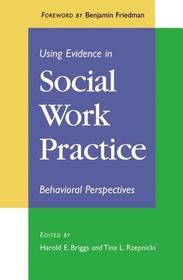
Using Evidence in Social Work Practice
Behavioral Perspectives
- Publisher's listprice GBP 71.00
-
32 056 Ft (30 530 Ft + 5% VAT)
The price is estimated because at the time of ordering we do not know what conversion rates will apply to HUF / product currency when the book arrives. In case HUF is weaker, the price increases slightly, in case HUF is stronger, the price goes lower slightly.
- Discount 10% (cc. 3 205 Ft off)
- Discounted price 28 851 Ft (27 477 Ft + 5% VAT)
Subcribe now and take benefit of a favourable price.
Subscribe
32 056 Ft

Availability
Uncertain availability. Please turn to our customer service.
Why don't you give exact delivery time?
Delivery time is estimated on our previous experiences. We give estimations only, because we order from outside Hungary, and the delivery time mainly depends on how quickly the publisher supplies the book. Faster or slower deliveries both happen, but we do our best to supply as quickly as possible.
Product details:
- Publisher OUP USA
- Date of Publication 1 June 2004
- ISBN 9780190615727
- Binding Paperback
- No. of pages376 pages
- Size 152x229x15 mm
- Weight 499 g
- Language English 0
Categories
Long description:
This important anthology reinforces the value of evidence-based practice. While the term evidence-based practice has only recently gained currency, it continues the social work tradition of applying scientific methods to practice.
In their introductory chapter, the editors stress the vital need for practitioners to share their research and experience with colleagues. There is an overwhelming body of literature in the field and to use it to the best advantage it is essential to learn the skills of critical thinking. The authors help the reader to evaluate the many sources of information, realize that even empirical knowledge is subject to revision, and balance conflicting views in order to make reasonable choices appropriate for one's own practice.
The scholars contributing to this work have helped shape the definition of contemporary social work practice. Their clear, concise chapters range from discussions about ethics, the nature of evidence, and the role of theory, through the addressing of widely varying, specific client problems, to selected issues that must be dealt with inside the social work system itself. Suitable for use in a variety of practice courses, this book will retain its value long after graduation as a source of helpful guidance and of lively discussion.
Using Evidence in Social Work Practice is a first-rate textbook. It introduces students to the notion of evidence in social work practice, and it links evidence-based practice to the traditions of critical thinking and scientific methods in social work. The text is a welcome addition to the social work literature." - Meredith Hanson, Fordham University
Table of Contents:
Foreword
Introduction Using Evidence in Your Practice
Part I Perspectives
Chapter 1 Contributions of Critical Thinking and Evidence-Based Practice to the Fulfillment of the Ethical Obligations of Professionals,
Chapter 2 Theory-Driven versus Theory-Free Research in Empirical Social Work Practice
Chapter 3 The Contribution of Operant Theory to Social Work Practice and Research
Chapter 4 Ecobehavioral Social Work
Chapter 5 Science in Evidence-Based Social Work Practice
Part II Applications
Chapter 6 Some Guidelines for Selecting Behavioral Intervention Programs for Children with Autism
Chapter 7 Evidence-Based Practice with Antisocial and Delinquent Youth: The Key Role of Family and Multisystemic Intervention
Chapter 8 Patterns of Juvenile Male Sexual Aggression: An Operant Approach (to Understanding and Intervening Effectively
Chapter 9 Behavioral Family Treatment in Japan: Design and Development of a Parent Training Program
Chapter 10 Adherence to HIV Therapies: Can Applied Behavior Analysis Help?
Chapter 11 Behavioral Programming and Staff Development in Adult Day Care
Chapter 12 Providing Appropriate Care in Advanced Dementia
Chapter 13 Behavior Interventions for Severe and Persistent Mental Disorders,
Part III Selected Issues
Chapter 14 Staff Development and Mental Health,
Chapter 15 The Evidence-Based Practitioner: Assessing the Cultural Responsiveness of Research,
Chapter 16 Informed Consent and Practice Evaluation: Making the Decision to Participate Meaningful
Chapter 17 Psychosocial Assessment of Teenage Parents: Lessons Learned in Its Application to Child Welfare
Chapter 18 Program Evaluation: Arduous, Impossible, and Political,
Chapter 19 Evaluating Science-Based Practice with Single Systems

