

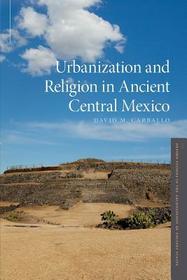
Urbanization and Religion in Ancient Central Mexico
Series: Oxford Studies in the Archaeology of Ancient States;
- Publisher's listprice GBP 37.99
-
17 152 Ft (16 335 Ft + 5% VAT)
The price is estimated because at the time of ordering we do not know what conversion rates will apply to HUF / product currency when the book arrives. In case HUF is weaker, the price increases slightly, in case HUF is stronger, the price goes lower slightly.
- Discount 10% (cc. 1 715 Ft off)
- Discounted price 15 437 Ft (14 702 Ft + 5% VAT)
Subcribe now and take benefit of a favourable price.
Subscribe
17 152 Ft

Availability
printed on demand
Why don't you give exact delivery time?
Delivery time is estimated on our previous experiences. We give estimations only, because we order from outside Hungary, and the delivery time mainly depends on how quickly the publisher supplies the book. Faster or slower deliveries both happen, but we do our best to supply as quickly as possible.
Product details:
- Publisher OUP USA
- Date of Publication 7 June 2018
- ISBN 9780190882334
- Binding Paperback
- No. of pages292 pages
- Size 234x156x15 mm
- Weight 413 g
- Language English
- Illustrations 55 illus. 0
Categories
Short description:
Urbanization and Religion in Ancient Central Mexico examines the ways in which urbanization and religion intersected in pre-Columbian central Mexico. It provides a materially informed history of religion and an archaeology of cities that considers religion as a generative force in societal change.
MoreLong description:
Urbanization and Religion in Ancient Central Mexico examines the ways in which urbanization and religion intersected in pre-Columbian central Mexico, with a primary focus on the later Formative period and the transition to the Classic period. The major societal transformations of this interval occurred approximately two-thousand years ago and over a millennium before Mexico's best known early civilization, the Aztecs. David M. Carballo presents a synthesis of data from regional archaeological projects and key sites such as Teotihuacan and Cuicuilco, while relying on his own excavations at the site of La Laguna as the central case study. A principal argument is that cities and states developed hand in hand with elements of a religious tradition of remarkable endurance and that these processes were fundamentally entangled. Prevalent religious beliefs and ritual practices created a cultural logic for urbanism, and as populations urbanized they became socially integrated and differentiated following this logic. Nevertheless, religion was used differently over time and by groups and individuals across the spectra of urbanity and social status. The book provides a materially informed history of religion, with the temporal depth that archaeology can provide, and an archaeology of cities that considers religion seriously as a generative force in societal change.
Researchers and students will find a solid book with carefully presented empirical case studies and an innovative theoretical perspective on key intellectual problems, such as urbanism, the formation of settlements and cities, and the organizational potential and unique materiality of cultural belief systems. The writing is precise and unpretentious. The photographs, illustrations, graphs, and maps are informative and well designed. Urbanization and Religion is also not an incredibly long book and, with Carballo's clear prose, will make an excellent assigned book for both undergraduate and graduate classes.
Table of Contents:
Contents
Preface
1. Religion and Urbanization in Ancient Societies
2. The Central Mexican Highlands and its People
3. Formative to Classic in Central Mexico
4. Sacred Landscapes
5. Sacred Actors
6. Ritual and Religion in the Creation of Urban Landscapes
Bibliography
Index

