

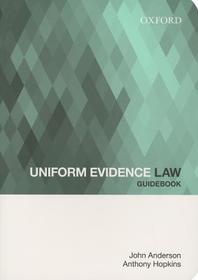
Uniform Evidence Law Guidebook
- Publisher's listprice GBP 35.99
-
16 249 Ft (15 475 Ft + 5% VAT)
The price is estimated because at the time of ordering we do not know what conversion rates will apply to HUF / product currency when the book arrives. In case HUF is weaker, the price increases slightly, in case HUF is stronger, the price goes lower slightly.
- Discount 10% (cc. 1 625 Ft off)
- Discounted price 14 624 Ft (13 928 Ft + 5% VAT)
Subcribe now and take benefit of a favourable price.
Subscribe
16 249 Ft

Availability
Only to order.
Why don't you give exact delivery time?
Delivery time is estimated on our previous experiences. We give estimations only, because we order from outside Hungary, and the delivery time mainly depends on how quickly the publisher supplies the book. Faster or slower deliveries both happen, but we do our best to supply as quickly as possible.
Product details:
- Publisher OUP Australia & New Zealand
- Date of Publication 6 November 2014
- ISBN 9780195523805
- Binding Paperback
- No. of pages384 pages
- Size 205x149x16 mm
- Weight 394 g
- Language English 0
Categories
Short description:
The Uniform Evidence Law Guidebook is the latest in the Guidebook series. It covers the fundamentals of evidence law in the uniform jurisdictions in Australia.
MoreLong description:
The Uniform Evidence Law Guidebook is the latest in the Guidebook series. It covers the fundamentals of evidence law in the uniform jurisdictions in Australia. It facilitates student learning by using accessible and clear language to explain complex concepts. Questions throughout the text and at end-chapter mirror the assessment types that students will encounter during the course of semester, to help practice skills and consolidate content knowledge.
Central to this guidebook is its capacity to facilitate student engagement with the process of proof, drawing and maintaining explicit links between theory and practice. Through the use of a Criminal Trial Thread Scenario, the guidebook enables students to become active participants in a trial, promoting deep experiential learning. Witness statements and other materials are provided for the majority of topics areas, with each new statement requiring students to apply their acquired knowledge incrementally in a progressive and continuous manner as either prosecution or defence lawyers. This 'taste of reality' experience also allows for incremental development of important skills in oral communication, decision-making and advocacy. In other topic areas, review problems are provided to encourage students to develop their analytical problem-solving skills in relation to realistic and typical evidence issues arising in the context of criminal and civil litigation.
Table of Contents:
1. Getting into Evidence
2. Proof and Presumptions
3. The Roles of Judge and Jury and the Judicial Discretion to Exclude Evidence
4. Witnesses and Adducing Evidence
5. Documentary and Real Evidence
6. Privileges and Immunities
7. Hearsay and Exceptions
8. Admissions
9. Opinions, Judgements and Convictions
10. Disposition Evidence I: Credibility and Character
11. Disposition Evidence II: Tendency and Coincidence
12. Identification Evidence

