

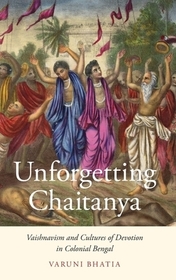
Unforgetting Chaitanya
Vaishnavism and Cultures of Devotion in Colonial Bengal
- Publisher's listprice GBP 115.00
-
51 922 Ft (49 450 Ft + 5% VAT)
The price is estimated because at the time of ordering we do not know what conversion rates will apply to HUF / product currency when the book arrives. In case HUF is weaker, the price increases slightly, in case HUF is stronger, the price goes lower slightly.
- Discount 20% (cc. 10 384 Ft off)
- Discounted price 41 538 Ft (39 560 Ft + 5% VAT)
- Discount is valid until: 30 June 2026
Subcribe now and take benefit of a favourable price.
Subscribe
51 922 Ft

Availability
Estimated delivery time: In stock at the publisher, but not at Prospero's office. Delivery time approx. 3-5 weeks.
Not in stock at Prospero.
Why don't you give exact delivery time?
Delivery time is estimated on our previous experiences. We give estimations only, because we order from outside Hungary, and the delivery time mainly depends on how quickly the publisher supplies the book. Faster or slower deliveries both happen, but we do our best to supply as quickly as possible.
Product details:
- Publisher OUP USA
- Date of Publication 21 September 2017
- ISBN 9780190686246
- Binding Hardback
- No. of pages312 pages
- Size 165x241x25 mm
- Weight 542 g
- Language English 0
Categories
Short description:
In Unforgetting Chaitanya, Varuni Bhatia examines late-nineteenth-century transformations of Vaishnavism--a vibrant and multifaceted religious tradition emanating from the Krishna devotee Chaitnaya (1486-1533)-in Bengal. Drawing on an extensive body of hitherto unexamined archival material, Bhatia finds that both Vaishnava modernizers and secular voices among the educated middle-class invoked Chaitanya, portraying him simultaneously as a local hero, a Hindu reformer, and as God almighty. She argues that these claims should be understood in relation to efforts to recover a "pure" Bengali culture and history at a time of rising anti-colonial sentiment.
MoreLong description:
What role do pre-modern religious traditions play in the formation of modern secular identities? In Unforgetting Chaitanya, Varuni Bhatia examines late-nineteenth-century transformations of Vaishnavism--a vibrant and multifaceted religious tradition emanating from the Krishna devotee Chaitnaya (1486-1533)--in Bengal. Drawing on an extensive body of hitherto unexamined archival material, Bhatia finds that both Vaishnava modernizers and secular voices among the educated middle-class invoked Chaitanya, portraying him simultaneously as a local hero, a Hindu reformer, and as God almighty. She argues that these claims should be understood in relation to efforts to recover a "pure" Bengali culture and history at a time of rising anti-colonial sentiment.
In the late nineteenth century, debates around questions of authenticity appeared prominently in the Bengali public sphere. These debates went on for years, even decades, causing unbridgeable rifts in personal friendships and tarnishing reputations of established scholars. Underlying them was the question of "true" Bengali Vaishnavism and its role in the long-term constitution of Bengali culture and society. Who was an authentic Vaishnava? Many authors excluded those groups and communities whose practices they found unacceptable according to their definition of Vaishnava authenticity. At stake in these discourses, argues Bhatia, was the nature and composition of an indigenously-derived modernity inscribed through what she calls the politics of authenticity. It allowed an influential section of Hindu Bengalis to excavate their own explicitly Hindu past in order to find a people's history, a religious reformer, a casteless Hindu sect, the richest examples of Bengali literature, and a sophisticated expression of monotheistic religion.
Unforgetting Chaitanya is a worthwhile reading for anyone interested in religion and the colonial encounter, rich in information and insight and gracefully written.
Table of Contents:
Acknowledgments
Note on Transliteration, Spelling, and Diacritics
Introduction
Chapter 1: Religion in Decline in an Age of Progress
Chapter 2: Untidy Realms
Chapter 3: A Swadeshi Chaitanya
Chapter 4: Recovering Bishnupriya's Loss
Chapter 5: Utopia and a Birthplace
Epilogue
Glossary
Bibliography

