

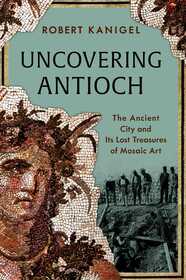
Uncovering Antioch
The Ancient City and Its Lost Treasures of Mosaic Art
-
GET 20% OFF
- Publisher's listprice GBP 20.00
-
9 030 Ft (8 600 Ft + 5% VAT)
The price is estimated because at the time of ordering we do not know what conversion rates will apply to HUF / product currency when the book arrives. In case HUF is weaker, the price increases slightly, in case HUF is stronger, the price goes lower slightly.
- Discount 20% (cc. 1 806 Ft off)
- Discounted price 7 224 Ft (6 880 Ft + 5% VAT)
- Discount is valid until: 31 October 2026
7 224 Ft

Availability
Not yet published.
Why don't you give exact delivery time?
Delivery time is estimated on our previous experiences. We give estimations only, because we order from outside Hungary, and the delivery time mainly depends on how quickly the publisher supplies the book. Faster or slower deliveries both happen, but we do our best to supply as quickly as possible.
Product details:
- Publisher Simon & Schuster
- Date of Publication 24 September 2026
- Number of Volumes Hardback
- ISBN 9781668006252
- Binding Hardback
- No. of pages320 pages
- Size 228x152x27 mm
- Weight 513 g
- Language English
- Illustrations 4-C 8-pg insert; b-w photos t-o; 700
Categories
Short description:
A history of the making, loss, and recovery of some of the greatest treasures of antiquity, which poses questions about the nature of museums and the meaning of art.
MoreLong description:
The story of the making, loss, and recovery of some of the greatest treasures of antiquity, raising questions about ancient mosaic art and its creation, the work of archaeology, and museum practice.
In 1932, after years of fundraising and flurries of letters back and forth, an archaeological team from Princeton University gathered in Antioch, Syria. They expected to find sculptures, frescos, palace walls, and busts. Instead, all across this ancient Roman metropolis, they stumbled upon one site after another of extraordinary mosaic treasure, incomparable in number, quality, and historical significance.
There were some three hundred of them in all, glories of color and design, stones and pieces of glass heaped up into spectacular images. Many of them were vast, room-sized tableaus, commissioned by wealthy Antiochenes for their villas. They depict banquets, drinking contests, olive harvests; lions, leopards, peacocks, and gazelles; legends, scenes from mythology, Cupid and Psyche, Narcissus and Dionysus. Though dated to early in the Christian era, they are unabashedly pagan; the animals and plants they depict are so life-like scholars can often identify them by species. A vast, collectively obsessive outpouring of industry and effort, art and artisanship, they stand for beauty, the drive to make it, and the human need to have it as part of life.
The eight-year dig at Antioch was an astonishing human enterprise, one that survived Depression-era financial downturns, interpersonal conflict, and the looming threat of World War II. Gained were mosaics that ultimately ended up in museums around the world—Harvard University, Boston’s Museum of Fine Arts, The Baltimore Museum of Art, New York’s Metropolitan, Paris’s Louvre, and more than a dozen others. But while an archaeological triumph, shedding new light on the ancient world, it also raised profound questions about the nature and progress of art. Who has a right to a work of art—the country of origin or the archaeologists who dig it up? Is art more interesting for its beauty, its history, or the craft and intelligence that goes into its making? What elevates a craftsperson into an artist? Robert Kanigel tackles these questions and more, breathing life into this landmark adventure of intellect and discovery.
“A richly detailed history of a grand treasure hunt.”
—Kirkus Reviews

