

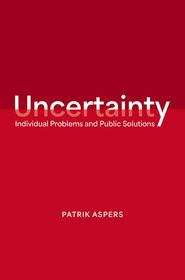
Uncertainty
Individual Problems and Public Solutions
- Publisher's listprice GBP 59.00
-
26 638 Ft (25 370 Ft + 5% VAT)
The price is estimated because at the time of ordering we do not know what conversion rates will apply to HUF / product currency when the book arrives. In case HUF is weaker, the price increases slightly, in case HUF is stronger, the price goes lower slightly.
- Discount 10% (cc. 2 663 Ft off)
- Discounted price 23 975 Ft (22 833 Ft + 5% VAT)
Subcribe now and take benefit of a favourable price.
Subscribe
26 638 Ft

Availability
Estimated delivery time: In stock at the publisher, but not at Prospero's office. Delivery time approx. 3-5 weeks.
Not in stock at Prospero.
Why don't you give exact delivery time?
Delivery time is estimated on our previous experiences. We give estimations only, because we order from outside Hungary, and the delivery time mainly depends on how quickly the publisher supplies the book. Faster or slower deliveries both happen, but we do our best to supply as quickly as possible.
Product details:
- Publisher OUP USA
- Date of Publication 20 December 2024
- ISBN 9780197752753
- Binding Hardback
- No. of pages232 pages
- Size 226x155x20 mm
- Weight 476 g
- Language English
- Illustrations 3 illustrations 547
Categories
Short description:
In Uncertainty, Patrik Aspers provides detailed analysis of publicly available means of uncertainty reduction. Examining what people can and in fact do to reduce uncertainty, Aspers addresses the existential dimension of uncertainty, the collective efforts and socially produced outcomes that lead to reduced uncertainty, and the social order that results.
MoreLong description:
This is an open access title available under the terms of a CC BY-NC-ND 4.0 International licence. It is free to read on the Oxford Academic platform and offered as a free PDF download from OUP and selected open access locations.
In Uncertainty, Patrik Aspers provides detailed analysis of publicly available means of uncertainty reduction. Drawing on phenomenology, social constructionism, and the sociology of knowledge, Aspers considers the meaningful differences between uncertainty and risk, the different ways people cope and have coped with uncertainty through history, the importance of knowledge and science to reducing uncertainty, and the trade-offs involved in reducing forms of uncertainty while leaving open opportunities for others.
People may have access to unique and private knowledge that reduces their uncertainty when making decisions. Publicly available knowledge is central for building a society that enables communication based on shared ideas and understanding, instead of falling into bubbles, echo chambers, and private truths. Examples include institutions, laws, standards, evaluation, competition, and ranking. The book addresses how these reduce uncertainty and how these ways are created.
Examining what people can and in fact do to reduce uncertainty, Aspers addresses the existential dimension of uncertainty, the collective efforts and socially produced outcomes that lead to reduced uncertainty, and the social order that results.
Table of Contents:
Preface
Acknowledgements
Chapter 1: How Much Can We Know?
Part I Principles of States of the World
Chapter 2: Informal Institutions
Chapter 3: Formal Institutions
Chapter 4: Evaluation
Part II: Forms Producing States of the World
Chapter 5: Convaluation
Chapter 6: Deciding for Others
Chapter 7: Contest
Chapter 8: Making and Reducing Uncertainty
Appendix I. A Typology of Convaluations
Notes
References

