

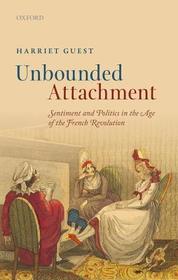
Unbounded Attachment
Sentiment and Politics in the Age of the French Revolution
- Publisher's listprice GBP 112.50
-
50 793 Ft (48 375 Ft + 5% VAT)
The price is estimated because at the time of ordering we do not know what conversion rates will apply to HUF / product currency when the book arrives. In case HUF is weaker, the price increases slightly, in case HUF is stronger, the price goes lower slightly.
- Discount 10% (cc. 5 079 Ft off)
- Discounted price 45 714 Ft (43 538 Ft + 5% VAT)
Subcribe now and take benefit of a favourable price.
Subscribe
50 793 Ft

Availability
printed on demand
Why don't you give exact delivery time?
Delivery time is estimated on our previous experiences. We give estimations only, because we order from outside Hungary, and the delivery time mainly depends on how quickly the publisher supplies the book. Faster or slower deliveries both happen, but we do our best to supply as quickly as possible.
Product details:
- Publisher OUP Oxford
- Date of Publication 14 November 2013
- ISBN 9780199686810
- Binding Hardback
- No. of pages226 pages
- Size 222x147x19 mm
- Weight 406 g
- Language English
- Illustrations 26 black-and-white halftones 0
Categories
Short description:
Unbounded Attachment discusses a range of British women writers, from Mary Wollstonecraft to Jane Austen, and considers the political implications of the language of feeling they use in their work.
MoreLong description:
Unbounded Attachment is about the uses of the language of sentiment in British women's writing from Mary Wollstonecraft to Jane Austen. It focuses on a range of writers for whom this language has the potential to hold together disparate elements in late eighteenth and early nineteenth-century society. This potential is important to the complex politics of Charlotte Smith's response, in her long poem The Emigrants, to the onset of war with France in 1793. The language of sentiment eases the transitions in Mary Robinson's writing between courtly praise for the French queen and liberal political opinion, and shapes her attitudes to the exchange between personal sociability and the expanding commercial market for her work. For women writers such as Amelia Alderson Opie and Elizabeth Inchbald the display of sentiment makes it possible to negotiate between the demands of commercial success and sociable or political allegiance. William Godwin admired Mary Wollstonecraft's capacity for an all-embracing sentiment of 'unbounded attachment' to humanity, and posthumous accounts such as Mary Hays's, as well as fictional heroines loosely based on Wollstonecraft's reputation, emphasised the strength of feeling, the enthusiasm, which united her private character and her politics, and evoked powerful responses from both her immediate social circle and her readers. The success of Jane Austen's novels depended on the access they gave readers to the privacy of her heroines' minds, where their sensibility apprehends an underlying coherence in the apparently disjointed social worlds in which they lived.
Readers will find in these essays many new perspectives on women writers making their way in a time of upheaval.
Table of Contents:
Introduction
Charlotte Smith, Mary Robinson, and the War with France in 1793
Mary Robinson in the Metropolis
Remembering Mary Wollstonecraft
Amelia Alderson and Mrs Opie: 'more of the woman'
'Inadvertencies and misconstructions': Jane Austen's heroines
Conclusion

