

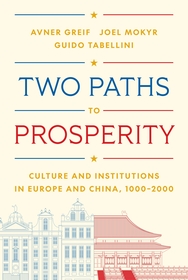
Two Paths to Prosperity
Culture and Institutions in Europe and China, 1000?2000
- Publisher's listprice GBP 35.00
-
15 802 Ft (15 050 Ft + 5% VAT)
The price is estimated because at the time of ordering we do not know what conversion rates will apply to HUF / product currency when the book arrives. In case HUF is weaker, the price increases slightly, in case HUF is stronger, the price goes lower slightly.
- Discount 10% (cc. 1 580 Ft off)
- Discounted price 14 222 Ft (13 545 Ft + 5% VAT)
Subcribe now and take benefit of a favourable price.
Subscribe
15 802 Ft

Availability
Estimated delivery time: In stock at the publisher, but not at Prospero's office. Delivery time approx. 3-5 weeks.
Not in stock at Prospero.
Why don't you give exact delivery time?
Delivery time is estimated on our previous experiences. We give estimations only, because we order from outside Hungary, and the delivery time mainly depends on how quickly the publisher supplies the book. Faster or slower deliveries both happen, but we do our best to supply as quickly as possible.
Product details:
- Publisher Princeton University Press
- Date of Publication 4 November 2025
- Number of Volumes Print PDF
- ISBN 9780691265940
- Binding Hardback
- No. of pages544 pages
- Size 234x155 mm
- Weight 906 g
- Language English
- Illustrations 16 b/w illus. 11 tables. 1 map. 1258
Categories
Long description:
How the social organization of Europe and China shaped their divergent economic and political trajectories over the past millennium
In the eleventh century, when Europe was still backward and poor, China was a rich and sophisticated civilization. Yet Europe became the birthplace of democracy and the Industrial Revolution, driving the Great Enrichment, while China stagnated until the end of the twentieth century and was always ruled by autocracies. Two Paths to Prosperity traces the emergence of two very different social organizations in premodern China and Europe—the clan and the corporation—showing how they were key factors in the economic and political divergence of these two great civilizations.
In this landmark book, three leading economists offer a bold new account of why Europe and China evolved along such different trajectories. In the early Middle Ages, public goods like risk sharing, religious worship, education, and conflict resolution were provided by nonstate organizations in both societies. China increasingly relied on kin-based cooperation within clans, while weaker kinship ties in Europe gave rise to corporations such as guilds, universities, and self-governing towns. Despite performing similar functions, clans and corporations were built on very different principles—with lasting consequences until today.
Providing a novel answer to a fundamental question in economic and political history, Two Paths to Prosperity shows how extended kinship in Chinese society facilitated the consolidation of autocracy and hindered innovation and economic development, and how corporations in Europe influenced emerging state institutions and set the stage for the Industrial Revolution.
"A New Yorker Best Book of the Year" More

