

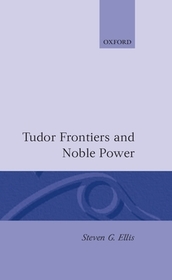
Tudor Frontiers and Noble Power
The Making of the British State
- Publisher's listprice GBP 177.50
-
80 141 Ft (76 325 Ft + 5% VAT)
The price is estimated because at the time of ordering we do not know what conversion rates will apply to HUF / product currency when the book arrives. In case HUF is weaker, the price increases slightly, in case HUF is stronger, the price goes lower slightly.
- Discount 10% (cc. 8 014 Ft off)
- Discounted price 72 127 Ft (68 693 Ft + 5% VAT)
Subcribe now and take benefit of a favourable price.
Subscribe
80 141 Ft

Availability
printed on demand
Why don't you give exact delivery time?
Delivery time is estimated on our previous experiences. We give estimations only, because we order from outside Hungary, and the delivery time mainly depends on how quickly the publisher supplies the book. Faster or slower deliveries both happen, but we do our best to supply as quickly as possible.
Product details:
- Publisher Clarendon Press
- Date of Publication 13 July 1995
- ISBN 9780198201335
- Binding Hardback
- No. of pages330 pages
- Size 225x141x24 mm
- Weight 528 g
- Language English
- Illustrations maps 0
Categories
Short description:
This book takes a new and controversial look at Tudor government and the formation of the British state, from the perspective of the borderlands which collectively made up over half of English territory. Ellis argues that it was the frontiers, not lowland England, which provided the real test of Tudor statesmanship. After 1534 the borderlands were drawn more closely into the Tudor state but by a policy which was seriously flawed and could not be applied to Scotland after 1603.
MoreLong description:
This controversial book offers a novel perspective on Tudor government and British state formation. It argues that traditional studies focusing on lowland England as 'the normal context of government' exaggerate the regime's successes by marginalizing the borderlands. Frontiers were normal in early-modern Europe, however, and central to the problem of state formation. England's peripheries were more extensive than the core and provide the real yardstick by which the effectiveness of government can be measured.
Ellis demonstrates their importance by means of a detailed comparative study of two marches - Cumbria and Ireland - and their ruling magnates. He demonstrates the flaws in early Tudor policy, characterized by long periods of neglect, interspersed with sporadic attempts to adapt, at minimal cost, a centralized administrative system geared to lowland England for the government of outlying regions which had very different social structures.
Ellis analyses the 1534 crisis in crown-magnate relations, reassesses the resulting policy of centralization and uniformity, and identifies the central role of these developments in establishing a British pattern of state formation.
a very personal scholarly statement ... The author has been well known for a number of years as an incisive and objective historian of Tudor Ireland. It is hard to quarrel with his detailed and painstaking research, or with the cautious and intelligent way in which his conclusions are presented.

