

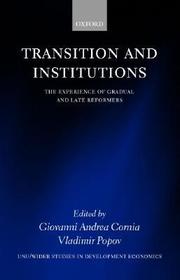
Transition and Institutions
The Experience of Gradual and Late Reformers
Series: WIDER Studies in Development Economics;
- Publisher's listprice GBP 67.00
-
32 009 Ft (30 485 Ft + 5% VAT)
The price is estimated because at the time of ordering we do not know what conversion rates will apply to HUF / product currency when the book arrives. In case HUF is weaker, the price increases slightly, in case HUF is stronger, the price goes lower slightly.
- Discount 10% (cc. 3 201 Ft off)
- Discounted price 28 808 Ft (27 437 Ft + 5% VAT)
Subcribe now and take benefit of a favourable price.
Subscribe
32 009 Ft

Availability
printed on demand
Why don't you give exact delivery time?
Delivery time is estimated on our previous experiences. We give estimations only, because we order from outside Hungary, and the delivery time mainly depends on how quickly the publisher supplies the book. Faster or slower deliveries both happen, but we do our best to supply as quickly as possible.
Product details:
- Publisher OUP Oxford
- Date of Publication 12 July 2001
- ISBN 9780199242184
- Binding Hardback
- No. of pages288 pages
- Size 243x164x20 mm
- Weight 559 g
- Language English
- Illustrations numerous tables and figures 0
Categories
Short description:
This book is a contribution to the debate about the transition process, and focuses on structural institutions in Russia and the East.
In transitional countries with unfavourable initial conditions and weak institutions, economic and social performance can only in part be explained by the approaches followed in the field of macroeconomic adjustment, privatization, and liberalization. By reviewing the impact of initial conditions on industrial and institutional conditions in the gradual and late reforming countries, this book aims to rekindle the debate surrounding these largely neglected issues.
Long description:
The gradual introduction of market reforms in China since 1978 and their subsequent massive and rapid adoption in the former Soviet bloc triggered an intense debate on the factors and policies which promote a smooth transition to a market economy. Particularly during its initial phase, such debate has focused on liberalization, privatization, and the macroeconomy of the countries of Central and Eastern Europe, and Russia. Other reforming economies and aspects increasingly recognized as key to a successful transition have received less attention in the academic literature.
This volume attempts to fill the gap by reviewing the often- neglected role of initial structural and institutional conditions and their subsequent development during the course of the transition. The volume focuses in particular on China, Russia, and the often-ignored countries of Central Asia, Vietnam, and those economies - such as Cuba and North Korea - which are in the very early phases of the reform process.
Table of Contents:
I. Introduction and overview
Structural and Institutional Factors in the Transition to the Market Economy: an Overview
II. Lessons from Selected Country Case Studies
Russia: Inconsistent Shock Therapy with Weakening Institutions
Reform Paths in Central Asian Transitional Economies
The Chinese Road to the Market: Achievements and Long-term Sustainability
Vietnam: Transition as a Socialist Project in East Asia
The Tortuous Road to the Market in North Korea: Problems and Prospects
Cuba: the Stalled Transition
III. Changes in Key Institutions
Economic Performance in Transitional Economies: the Role of Ownership, Incentives and Restructuring
Unorthodox Ownership and Governance Structures in Transitional East Asia
Transition Approaches, Institutions and Income Inequality
Informal Institutions, Social Capital and Economic Transition: Reflections on a Neglected Dimension

