

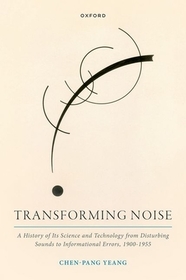
Transforming Noise
A History of Its Science and Technology from Disturbing Sounds to Informational Errors, 1900-1955
- Publisher's listprice GBP 60.00
-
27 090 Ft (25 800 Ft + 5% VAT)
The price is estimated because at the time of ordering we do not know what conversion rates will apply to HUF / product currency when the book arrives. In case HUF is weaker, the price increases slightly, in case HUF is stronger, the price goes lower slightly.
- Discount 10% (cc. 2 709 Ft off)
- Discounted price 24 381 Ft (23 220 Ft + 5% VAT)
Subcribe now and take benefit of a favourable price.
Subscribe
27 090 Ft

Availability
Estimated delivery time: In stock at the publisher, but not at Prospero's office. Delivery time approx. 3-5 weeks.
Not in stock at Prospero.
Why don't you give exact delivery time?
Delivery time is estimated on our previous experiences. We give estimations only, because we order from outside Hungary, and the delivery time mainly depends on how quickly the publisher supplies the book. Faster or slower deliveries both happen, but we do our best to supply as quickly as possible.
Product details:
- Publisher OUP Oxford
- Date of Publication 30 October 2023
- ISBN 9780198887768
- Binding Hardback
- No. of pages492 pages
- Size 240x165x300 mm
- Weight 978 g
- Language English
- Illustrations 32 line illustrations and halftones 433
Categories
Short description:
Transforming Noise examines the historical origin of the attempts to understand, control, and use noise in modern times. The book sheds light on the interactions between physics, mathematics, mechanical technology, electrical engineering, and information and data sciences in the twentieth century.
MoreLong description:
Today, the concept of noise is employed to characterize random fluctuations in general. Before the twentieth century, however, noise only meant disturbing sounds. In the 1900s-50s, noise underwent a conceptual transformation from unwanted sounds that needed to be domesticated into a synonym for errors and deviations to be now used as all kinds of signals and information. Transforming Noise examines the historical origin of modern attempts to understand, control, and use noise. Its history sheds light on the interactions between physics, mathematics, mechanical technology, electrical engineering, and information and data sciences in the twentieth century.
This book explores the process of engineers and physicists turning noise into an informational concept, starting from the rise of sound reproduction technologies such as the phonograph, telephone, and radio in the 1900s-20s until the theory of Brownian motions for random fluctuations and its application in thermionic tubes of telecommunication systems. These processes produced different theoretical treatments of noise in the 1920s-30s, such as statistical physicists' studies of Brownian fluctuations' temporal evolution, radio engineers' spectral analysis of atmospheric disturbances, and mathematicians' measure-theoretic formulation. Finally, it discusses the period during and after World War II and how researchers have worked on military projects of radar, gunfire control, and secret communications and converted the interwar theoretical studies of noise into tools for statistical detection, estimation, prediction, and information transmission.
To physicists, mathematicians, electrical engineers, and computer scientists, this book offers a historical perspective on themes highly relevant in today's science and technology, ranging from Wi-Fi and big data to quantum information and self-organization. This book also appeals to environmental and art historians to modern music scholars as the history of noise constitutes a unique angle to study sound and society. Finally, to researchers in media studies and digital cultures, Transforming Noise demonstrates the deep technoscientific historicity of certain notions - information, channel, noise, equivocation - they have invoked to understand modern media and communication.
An important contribution to the history of science and technology in the first half of the twentieth century.
Table of Contents:
Introduction
Discordance and nuisance
Materializing cacophony: surface noise on phonographic records
Measuring noise: from ear-balance to self-registration
Brownian motion and the origin of stochastic processes
Electronic noise in telecommunications
Dynamics of Brownian motion
Spectrum of random noise
A mathematical foundation of fluctuations
Noise in radar detection
Filtering noise for antiaircraft gunfire control
Information, cryptography, and noise
Spread-spectrum communication
Conclusion

