

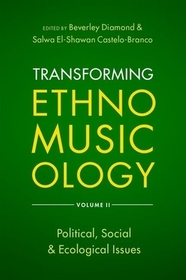
Transforming Ethnomusicology Volume II
Political, Social & Ecological Issues
- Publisher's listprice GBP 22.99
-
10 379 Ft (9 885 Ft + 5% VAT)
The price is estimated because at the time of ordering we do not know what conversion rates will apply to HUF / product currency when the book arrives. In case HUF is weaker, the price increases slightly, in case HUF is stronger, the price goes lower slightly.
- Discount 10% (cc. 1 038 Ft off)
- Discounted price 9 341 Ft (8 897 Ft + 5% VAT)
Subcribe now and take benefit of a favourable price.
Subscribe
10 379 Ft

Availability
Estimated delivery time: In stock at the publisher, but not at Prospero's office. Delivery time approx. 3-5 weeks.
Not in stock at Prospero.
Why don't you give exact delivery time?
Delivery time is estimated on our previous experiences. We give estimations only, because we order from outside Hungary, and the delivery time mainly depends on how quickly the publisher supplies the book. Faster or slower deliveries both happen, but we do our best to supply as quickly as possible.
Product details:
- Publisher OUP USA
- Date of Publication 30 September 2021
- ISBN 9780197517567
- Binding Paperback
- No. of pages270 pages
- Size 234x155x17 mm
- Weight 363 g
- Language English
- Illustrations 16 figures 125
Categories
Short description:
This two-volume collection transforms our understanding of the discipline of ethnomusicology by exploring how ethnomusicologists can contribute to positive social and environmental change within institutional frameworks. The second volume focuses on the intersection of ecological and social issues and features a variety of Indigenous perspectives
MoreLong description:
For decades, ethnomusicologists across the world have considered how to affect positive change for the communities they work with. Through illuminating case studies and reflections by a diverse array of scholars and practitioners, Transforming Ethnomusicology aims to both expand dialogues about social engagement within ethnomusicology and, at the same time, transform how we understand ethnomusicology as a discipline.
The second volume of Transforming Ethnomusicology takes as a point of departure the recognition that colonial and environmental damages are grounded in historical and institutional failures to respect the land and its peoples. Featuring Indigenous and other perspectives from Brazil, North America, Australia, Africa, and Europe this volume critically engages with how ethnomusicologists can support marginalized communities in sustaining their musical knowledge and threatened geographies.
A highly original and unusually rewarding read. If anyone wondered what twenty-first century ethnomusicology could become, Transforming Ethnomusicology provides creative ideas and inspiration. Bursting with fresh insights, it speaks to issues of major concern and defines the field.
Table of Contents:
Ethnomusicological Praxis: An Introduction
Beverley Diamond and Salwa El-Shawan Castelo-Branco
Chapter 1: A Sound Economy
Jeff Todd Titon
Chapter 2: Music for Global Human Development
Michael Frishkopf
Chapter 3: Reengaging Sound Praxis in the Real World: Politico-Epistemological Dimensions of Dialogue and Participation in Knowledge Production
Samuel Araujo
Chapter 4: Silenced Registers of Ethnomusicological Academic Labor under Neoliberalism
Ana Hofman
Chapter 5: Sonic Mapping and Critical Citizenship: Reflections on LimerickSoundscapes
Aileen Dillane and Tony Langlois
Chapter 6: The Earth Is (Still) Our Mother: Traversing Indigenous Landscapes through Sacred Geographies of Song
Chad Hamill
Chapter 7: The Modernity of the Songlines
Rhoda Roberts
Chapter 8: Music Endangerment, Repatriation and Intercultural Collaboration in an Australian Discomfort Zone
Sally Treloyn and Rona Goonginda Charles
Chapter 9: Dancing Domba: Intersections of Ethnomusicology, Music Education, and Research with Children and Young People
Andrea Emberly and Mudzunga Junniah Davhula
Chapter 10: Ethical Friction: IRBs, Ethnolmusicological Ethics, and Music in an American Jail
Andy McGraw
Chapter 11: Ethnomusicology and the Meeting of Knowledges in Music: The Inclusion of Masters of Traditional Musics as Lecturers in Higher Education Institutions
José Jorge de Carvalho

