

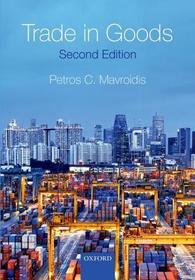
Trade in Goods
Series: Oxford Commentaries on International Law; 1;
- Publisher's listprice GBP 94.00
-
42 441 Ft (40 420 Ft + 5% VAT)
The price is estimated because at the time of ordering we do not know what conversion rates will apply to HUF / product currency when the book arrives. In case HUF is weaker, the price increases slightly, in case HUF is stronger, the price goes lower slightly.
- Discount 10% (cc. 4 244 Ft off)
- Discounted price 38 197 Ft (36 378 Ft + 5% VAT)
Subcribe now and take benefit of a favourable price.
Subscribe
42 441 Ft

Availability
printed on demand
Why don't you give exact delivery time?
Delivery time is estimated on our previous experiences. We give estimations only, because we order from outside Hungary, and the delivery time mainly depends on how quickly the publisher supplies the book. Faster or slower deliveries both happen, but we do our best to supply as quickly as possible.
Product details:
- Edition number 2
- Publisher OUP Oxford
- Date of Publication 15 August 2013
- ISBN 9780199689750
- Binding Paperback
- No. of pages944 pages
- Size 246x173x52 mm
- Weight 1598 g
- Language English 0
Categories
Short description:
Providing the definitive analysis of the establishment and operation of international trade agreements by one of the most influential experts in the field, this book examines the economic rationale behind the current framework of international trade, and investigates the role of trade agreements in securing the benefits of a global economy.
MoreLong description:
This new edition of Trade in Goods is an authoritative work on international trade by one of the most influential scholars in the field. It provides a comprehensive and detailed analysis of every WTO agreement dealing with trade in goods. The focus of the book is on the reasoning behind the various WTO agreements and their provisions, and the manner in which they have been understood in practice. It introduces both the historic as well as the economic rationale for the emergence of the multilateral trading system, before dealing with WTO practice in all areas involving trade in goods. It contests the claim that the international trade agreements themselves represent 'incomplete contracts', realized through interpretation by the WTO and other judicial bodies. The book comprehensively analyses the WTO's case law, and it argues that a more rigorous theoretical approach is needed to ensure a greater coherence in the interpretation of the core provisions regulating trade in goods.
This second edition readdresses and moves beyond the discussion of the GATT presented in the first edition to assess in significant detail every trade in goods agreement at the WTO, both multilateral as well as plurilateral. The book is written to be accessible to those new to the field, with an authoritative level of detail and analysis that makes it essential reading for lawyers and economists alike.
Petros Mavroidis, the leading trade jurist of his generation, has written an astonishingly effective text which has trained large numbers of the best trade lawyers recently, as I can testify having worked with it in Columbia Law School classes where I have co-taught WTO Dispute Settlement Law for some years. The second edition makes it yet better; no rival text comes remotely close in its erudition and its comprehensiveness.
Table of Contents:
From GATT to the WTO
Disciplining Trade Instruments in the GATT
Most Favoured Nation and Exceptions
Domestic Instruments
Deviating from WTO Obligations
Agreements Dealing with Customs Procedures
Antidumping
Subsidies
Safeguards
Technical Barriers to Trade: Sanitary and Phyto-sanitary Measures
Agreement on Agriculture; Agreement on Textiles and Clothing
Government Procurement
Transparency
Conclusions

