

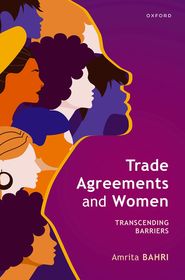
Trade Agreements and Women
Transcending Barriers
- Publisher's listprice GBP 105.00
-
47 407 Ft (45 150 Ft + 5% VAT)
The price is estimated because at the time of ordering we do not know what conversion rates will apply to HUF / product currency when the book arrives. In case HUF is weaker, the price increases slightly, in case HUF is stronger, the price goes lower slightly.
- Discount 10% (cc. 4 740 Ft off)
- Discounted price 42 667 Ft (40 635 Ft + 5% VAT)
Subcribe now and take benefit of a favourable price.
Subscribe
47 407 Ft

Availability
Estimated delivery time: In stock at the publisher, but not at Prospero's office. Delivery time approx. 3-5 weeks.
Not in stock at Prospero.
Why don't you give exact delivery time?
Delivery time is estimated on our previous experiences. We give estimations only, because we order from outside Hungary, and the delivery time mainly depends on how quickly the publisher supplies the book. Faster or slower deliveries both happen, but we do our best to supply as quickly as possible.
Product details:
- Publisher OUP Oxford
- Date of Publication 13 February 2025
- ISBN 9780198935728
- Binding Hardback
- No. of pages304 pages
- Size 240x162x23 mm
- Weight 610 g
- Language English 562
Categories
Short description:
Trade Agreements and Women explores how trade agreements might be altered to more effectively address women's interests. The book provides gender-sensitive guidance for preparing, revising, and negotiating trade regulations in an inclusive manner, ensuring that they work for all.
MoreLong description:
With more and more countries including provisions on women's concerns in their trade agreements, Trade Agreements and Women: Transcending Barriers explores how women's empowerment and trade liberalization interact, overlap, and converge.
Tapping into examples from across the globe, and taking into consideration the diverse political, economic, social, and legal contexts of different countries, Amrita Bari poses and answers some key questions: What role can trade agreements play with regard to women's empowerment, and what limitations do they have? Have previous efforts to include women through trade agreements been genuinely responsive to the needs of women, or have they been merely symbolic? What, ultimately, makes a trade agreement responsive to the needs of women, and how can countries achieve this in their own trade agreements?
In answering these questions, Bahri carves out a roadmap, with concrete recommendations, for the future of women-related trade provisions, and offers much-needed guidance for legal scholars, trade negotiators, and policymakers involved in preparing, revising, and inclusively negotiating trade regulations.
This is a remarkable book as it courageously raises all the right, but sometimes uncomfortable, questions and masterly guides us in our own search for answers. What are the barriers to women's economic empowerment and how are they related to trade? Can trade agreements play a role in overcoming these barriers? What can be learned from efforts already made in this regard? What should/could be done next to ensure that trade genuinely works for all, particularly those who have been historically marginalized, as women have? Amrita Bahri's timely book makes an important contribution to the discussion on how trade agreements can maximize the benefits and minimize the negative impact that trade may have on women.
Table of Contents:
Introduction
Barriers that Impede Women's Economic Empowerment
Trade and Women: Understanding the Nexus
Can WTO Laws and Institutions Empower Women?
Can Trade Agreements Empower Women?
Hesitations and Pitfalls that Impede the Inclusion of Women's Concerns in FTAs
Measuring Gender-Responsiveness of Trade Agreements: Using the Maturity Framework
Trade Agreements Can Empower Women: A Look at Practice Examples
Problems with the Existing Inclusions on Women and Trade
The Pentagon Roadmap for Trade and Gender Negotiations: Five-Dimensional Policy Recommendations

