

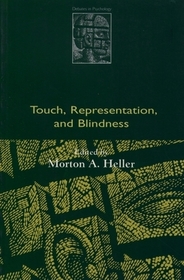
Touch, Representation, and Blindness
Series: Debates in Psychology;
- Publisher's listprice GBP 82.00
-
37 023 Ft (35 260 Ft + 5% VAT)
The price is estimated because at the time of ordering we do not know what conversion rates will apply to HUF / product currency when the book arrives. In case HUF is weaker, the price increases slightly, in case HUF is stronger, the price goes lower slightly.
- Discount 10% (cc. 3 702 Ft off)
- Discounted price 33 321 Ft (31 734 Ft + 5% VAT)
Subcribe now and take benefit of a favourable price.
Subscribe
37 023 Ft

Availability
printed on demand
Why don't you give exact delivery time?
Delivery time is estimated on our previous experiences. We give estimations only, because we order from outside Hungary, and the delivery time mainly depends on how quickly the publisher supplies the book. Faster or slower deliveries both happen, but we do our best to supply as quickly as possible.
Product details:
- Publisher OUP Oxford
- Date of Publication 23 March 2000
- ISBN 9780198503873
- Binding Paperback
- No. of pages236 pages
- Size 234x156x14 mm
- Weight 358 g
- Language English
- Illustrations line figures 0
Categories
Short description:
Psychological studies of touch and blindness have been fraught with controversy. Within this field there exist important theoretical divides. New to the Debates in Psychology series, Touch, Representation, and Blindness brings together the leading investigators in these areas, each presenting the evidence for their side of the debate. An introductory chapter sets the theoretical and historical stage for the debate, and a concluding chapter draws together the different views and ideas set forth by the contributors, summarizing and clarifying the discussion.
MoreLong description:
Psychological studies of touch and blindness have been fraught with controversy. Within this field there remains an important theoretical divide. Many researchers have taken a cognitive approach to the study of touch and blindness, relating these to higher order processes, such as memory and concept formation. Others adopt a theoretical perspective, arguing that it not necessary to consider the 'internal representation' of the stimuli, when investigating touch - thus people make use of information from the physical biomechanical properties of their limbs as they assess the physical properties of objects. In addition, psychologists differ in the relative importance they place on the modality of sensory stimulation for subsequent perceptual experiences. Some psychologists argue that touch can do many of the things that are accomplished by vision, and claim that the mode of sensory stimulation is not critically important for perception, arguing that much information can be obtained through non-visual modalities. Others suggest that there are important consequences of a lack of visual experience, arguing for the importance of multiple forms of sensory input for conceptual development. New to the Debates in Psychology series, Touch, Representation, and Blindness brings together the leading investigators in these areas, each presenting the evidence for their side of the debate. An introductory chapter sets the theoretical and historical stage for the debate, and a concluding chapter draws together the different views and ideas set forth by the contributors, summarizing and resolving the discussion.
MoreTable of Contents:
Introduction: the theoretical context for the dialog
Rotational invariants and dynamic touch
Recognizing outline pictures via touch: alignment theory
Modality and mind: convergent active processing in interrelated networks as a model of development and perception by touch
Mental imagery in blind people: the role of passive and active visuospatial processes
Conclusions: the San Marino discussion

