

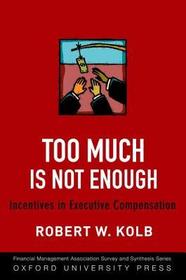
Too Much Is Not Enough
Incentives in Executive Compensation
Series: Financial Management Association Survey and Synthesis Series;
- Publisher's listprice GBP 53.00
-
23 929 Ft (22 790 Ft + 5% VAT)
The price is estimated because at the time of ordering we do not know what conversion rates will apply to HUF / product currency when the book arrives. In case HUF is weaker, the price increases slightly, in case HUF is stronger, the price goes lower slightly.
- Discount 10% (cc. 2 392 Ft off)
- Discounted price 21 537 Ft (20 511 Ft + 5% VAT)
Subcribe now and take benefit of a favourable price.
Subscribe
23 929 Ft

Availability
printed on demand
Why don't you give exact delivery time?
Delivery time is estimated on our previous experiences. We give estimations only, because we order from outside Hungary, and the delivery time mainly depends on how quickly the publisher supplies the book. Faster or slower deliveries both happen, but we do our best to supply as quickly as possible.
Product details:
- Publisher OUP USA
- Date of Publication 23 August 2012
- ISBN 9780199829583
- Binding Hardback
- No. of pages232 pages
- Size 236x155x22 mm
- Weight 454 g
- Language English
- Illustrations 36 b/w line 0
Categories
Short description:
In Too Much Is Not Enough, Robert W. Kolb studies the performance of incentives in executive compensation across many dimensions of CEO performance.
MoreLong description:
The scholarly literature on executive compensation is vast. As such, this literature provides an unparalleled resource for studying the interaction between the setting of incentives (or the attempted setting of incentives) and the behavior that is actually adduced. From this literature, there are several reasons for believing that one can set incentives in executive compensation with a high rate of success in guiding CEO behavior, and one might expect CEO compensation to be a textbook example of the successful use of incentives. Also, as executive compensation has been studied intensively in the academic literature, we might also expect the success of incentive compensation to be well-documented. Historically, however, this has been very far from the case.
In Too Much Is Not Enough, Robert W. Kolb studies the performance of incentives in executive compensation across many dimensions of CEO performance. The book begins with an overview of incentives and unintended consequences. Then it focuses on the theory of incentives as applied to compensation generally, and as applied to executive compensation particularly. Subsequent chapters explore different facets of executive compensation and assess the evidence on how well incentive compensation performs in each arena. The book concludes with a final chapter that provides an overall assessment of the value of incentives in guiding executive behavior. In it, Kolb argues that incentive compensation for executives is so problematic and so prone to error that the social value of giving huge incentive compensation packages is likely to be negative on balance. In focusing on incentives, the book provides a much sought-after resource, for while there are a number of books on executive compensation, none focuses specifically on incentives. Given the recent fervor over executive compensation, this unique but logical perspective will garner much interest. And while the literature being considered and evaluated is technical, the book is written in a non-mathematical way accessible to any college-educated reader.
Assessing the effectiveness of executive pay arrangements in providing desirable incentives presents important questions and has generated a tremendous amount of research. Making this research accessible to a wider audience, and drawing on it to discuss how pay arrangements can be improved, Too Much is Not Enough is a welcome contribution to the ongoing debates on the subject.
Table of Contents:
Preface
1. The Magnitude and Structure of Executive Compensation
The Magnitude of CEO Compensation
The Structure of Executive Compensation
Salary
Bonuses and Long-Term Incentive Plans
Restricted Stock Awards
Executive Stock Option (ESO) Awards
Other Forms of Compensation
2. Corporate Governance, Agency Problems, and Executive Compensation
Corporate Governance
Agency Theory and Incentive Alignment
Corporate Governance, Incentive Alignment, and the Managerial Power Hypothesis
The Levers of Managerial Power
Limits to Pay on the Managerial Power Hypothesis
Assessing the Conceptual Conflict Between the Agency-Theoretic and Managerial Power Views of Executive Compensation
What about Ethics, Duty, and Justice?
Fiduciary Duty
Executive Compensation and Distributive Justice
3. The Incentive Structure of Executive Compensation
The Incentive Revolution and Executive Compensation
Salary
Bonuses
Restricted Stock and Performance Shares
Executive Stock Options
Equity Compensation: Retaining the Employees You Have, and Attracting the Ones You Want
Different Instruments as Tools of Incentive Compensation
4. Executive Stock Options and the Incentives They Create
ESO Incentives, Firm Practices, and the Effect of Accounting Rules
Option Pricing Models
Option Valuation Effects of Individual Option Parameters
The Option Pricing Model and Incentives
Executive Stock Option Design, Management, and Incentives
What Exercise Price?
Repricing and Reloading Executive Stock Options
The CEO's Utility and the Desire for ESOs
5. Executive Stock Option Programs: The Behavior of CEOs, Firms, and Investors
CEO Wealth, Pay, and Performance
Exercise of ESOs
BOX 1: Detecting Abnormal Stock Market Performance
Unwinding Incentives
6. Executive Incentives and Risk-Taking
Equity Compensation and the CEO's Risk Appetite
Executive Compensation and the Risk-Taking Behavior of CEOs
Incentive Compensation, Risk-Taking, and the Financial Crisis of 2007-2009
7. Incentive Compensation and the Management of the Firm
Incentive Compensation and the Firm's Investment Program
CEO Incentives and the Firm's Financing Decisions
Compensation Incentives, Dividends, and Share Repurchases,
Corporate Mergers, Acquisitions, and Liquidations
Compensation Incentives and Corporate Risk Management
Compensation Incentives and Corporate Disclosures
8. Perverse Incentive Effects: Executives Behaving Badly
Earnings Management
Option Games and Exploitation
Option Games: A Warning About Incentives in Executive Compensation
9. Incentives in Executive Compensation: A Final Assessment
Incentive Compensation and the Level of Executive Pay
New Legislation and the Shaping of Incentives
How Dysfunctional is Executive Pay?
On Balance, Is Incentive Compensation Beneficial?
To Improve Executive Compensation, Improve Corporate Governance
Executive Pay, Continuing Inequality, and the Question of Justice
Appendix: Binomial Valuation Method for Executive Stock Options
Notes
References
Index

