

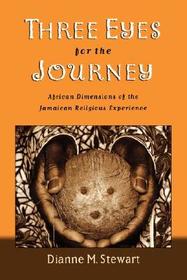
Three Eyes for the Journey
African Dimensions of the Jamaican Religious Experience
- Publisher's listprice GBP 37.99
-
17 152 Ft (16 335 Ft + 5% VAT)
The price is estimated because at the time of ordering we do not know what conversion rates will apply to HUF / product currency when the book arrives. In case HUF is weaker, the price increases slightly, in case HUF is stronger, the price goes lower slightly.
- Discount 10% (cc. 1 715 Ft off)
- Discounted price 15 437 Ft (14 702 Ft + 5% VAT)
Subcribe now and take benefit of a favourable price.
Subscribe
17 152 Ft

Availability
printed on demand
Why don't you give exact delivery time?
Delivery time is estimated on our previous experiences. We give estimations only, because we order from outside Hungary, and the delivery time mainly depends on how quickly the publisher supplies the book. Faster or slower deliveries both happen, but we do our best to supply as quickly as possible.
Product details:
- Publisher OUP USA
- Date of Publication 28 July 2005
- ISBN 9780195175578
- Binding Paperback
- No. of pages368 pages
- Size 235x157x20 mm
- Weight 508 g
- Language English
- Illustrations 4 maps, 4 tables 0
Categories
Short description:
Studies of African-derived religious traditions have generally focused on their retention of African elements. This emphasis, says Dianne Stewart, slights the ways in which communities in the African diaspora have created and formed new religious meaning. In this fieldwork-based study Stewart shows that African people have been agents of their own religious, ritual, and theological formation. She examines the African-derived and African-centered traditions in historical and contemporary Jamaica: Myal, Obeah, Native Baptist, Revival/Zion, Kumina, and Rastafari, and draws on them to forge a new womanist liberation theology for the Caribbean.
MoreLong description:
Studies of African-derived religious traditions have generally focused on their retention of African elements. This emphasis, says Dianne Stewart, slights the ways in which communities in the African diaspora have created and formed new religious meaning. In this fieldwork-based study Stewart shows that African people have been agents of their own religious, ritual, and theological formation. She examines the African-derived and African-centered traditions in historical and contemporary Jamaica: Myal, Obeah, Native Baptist, Revival/Zion, Kumina, and Rastafari, and draws on them to forge a new womanist liberation theology for the Caribbean.
What Stewart is speaking for in a remarkable trans-discipline manner is a revision which allows religions to be able to talk with--rather than howl at--one another. Stewarts scholarship makes a major pathfinding and breakthrough contribution to theological studies, Caribbean theology in particular, and Caribbean studies.

