

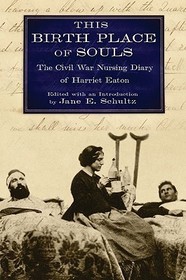
This Birth Place of Souls
The Civil War Nursing Diary of Harriet Eaton
- Publisher's listprice GBP 110.00
-
49 665 Ft (47 300 Ft + 5% VAT)
The price is estimated because at the time of ordering we do not know what conversion rates will apply to HUF / product currency when the book arrives. In case HUF is weaker, the price increases slightly, in case HUF is stronger, the price goes lower slightly.
- Discount 10% (cc. 4 967 Ft off)
- Discounted price 44 699 Ft (42 570 Ft + 5% VAT)
Subcribe now and take benefit of a favourable price.
Subscribe
49 665 Ft

Availability
printed on demand
Why don't you give exact delivery time?
Delivery time is estimated on our previous experiences. We give estimations only, because we order from outside Hungary, and the delivery time mainly depends on how quickly the publisher supplies the book. Faster or slower deliveries both happen, but we do our best to supply as quickly as possible.
Product details:
- Publisher OUP USA
- Date of Publication 23 December 2010
- ISBN 9780195392685
- Binding Hardback
- No. of pages352 pages
- Size 165x241x25 mm
- Weight 638 g
- Language English
- Illustrations 17 black and white halftones 0
Categories
Short description:
Published for the first time, Harriet Eaton's nursing diary is rare among Civil War narratives. A church-sponsored relief agent, the widowed Eaton left children at home while she tended to soldiers in the field. Not one to mince words, Eaton tussled with co-workers and surgeons, illuminating the politics of military medicine and the moral challenges that beset aid workers.
MoreLong description:
After the battle of Antietam in 1862, Harriet Eaton traveled to Virginia from her home in Portland, Maine, to care for soldiers in the Army of the Potomac. Portland's Free Street Baptist Church, with liberal ties to abolition, established the Maine Camp Hospital Association and made the widowed Eaton its relief agent in the field. One of many Christians who believed that patriotic activism could redeem the nation, Eaton quickly learned that war was no respecter of religious principles.
Doing the work of nurse and provisioner, Eaton tended wounded men and those with smallpox and diphtheria during two tours of duty. She preferred the first tour, which ended after the battle of Chancellorsville in 1863, to the second, more sedentary, assignment at City Point, Virginia, in 1864. There the impositions of federal bureaucracy standardized patient care at the expense of more direct communication with soldiers. Eaton deplored the arrogance of U.S. Sanitary Commissioners whom she believed saw state benevolent groups as competitors for supplies.
Eaton struggled with the disruptions of transience, scarcely sleeping in the same place twice, but found the politics of daily toil even more challenging. Conflict between Eaton and co-worker Isabella Fogg erupted almost immediately over issues of propriety; the souring working conditions leading to Fogg's ouster from Maine state relief efforts by late 1863. Though Eaton praised some of the surgeons with whom she worked, she labeled others charlatans whose neglect had deadly implications for the rank and file. If she saw villainy, she also saw opportunities to convert soldiers and developed an intense spiritual connection with a private, which appears to have led to a postwar liaison.
Published here for the first time, the uncensored nursing diary is a rarity among medical accounts of the war, showing Eaton to be an astute observer of human nature and not as straight-laced as we might have thought. This hardcover edition includes an extensive introduction from the editor, transcriptions of relevant letters and newspaper articles, and a thoroughly researched biographical dictionary of the people mentioned in the diary.
Jane Schultz is arguably the nation's leading expert on Civil War nursing, whose articles and book, Women at the Front, have had a profound effect on how scholars-including literary critics and historians-have viewed women's contributions to the American Civil War. First-person accounts of northern women nurses (and of northern women in general) during the Civil War remain rare-and so it is a pleasure to see that Schultz has produced this carefully edited and beautifully written volume documenting Harriet Eaton's nursing. This is a great discovery and a significant contribution to Civil War literature
Table of Contents:
Introduction
The Diary
1862: 6 October to 31 December
1863: 1 January to 12 May
1864: 12 October to 24 December
Notes
Appendixes
Transcriptions of Letters and Newspaper Items
Biographical Dictionary
Bibliography
Index

