

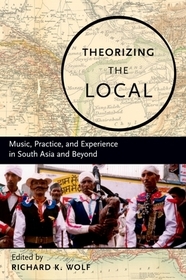
Theorizing the Local
Music, Practice, and Experience in South Asia and Beyond
- Publisher's listprice GBP 33.99
-
15 346 Ft (14 615 Ft + 5% VAT)
The price is estimated because at the time of ordering we do not know what conversion rates will apply to HUF / product currency when the book arrives. In case HUF is weaker, the price increases slightly, in case HUF is stronger, the price goes lower slightly.
- Discount 10% (cc. 1 535 Ft off)
- Discounted price 13 811 Ft (13 154 Ft + 5% VAT)
Subcribe now and take benefit of a favourable price.
Subscribe
15 346 Ft

Availability
printed on demand
Why don't you give exact delivery time?
Delivery time is estimated on our previous experiences. We give estimations only, because we order from outside Hungary, and the delivery time mainly depends on how quickly the publisher supplies the book. Faster or slower deliveries both happen, but we do our best to supply as quickly as possible.
Product details:
- Publisher OUP USA
- Date of Publication 17 September 2009
- ISBN 9780195331387
- Binding Paperback
- No. of pages344 pages
- Size 231x155x20 mm
- Weight 499 g
- Language English
- Illustrations 50 black and white half tone, 54 line illustrations 0
Categories
Short description:
Theorizing the Local rethinks South Asian music in light of diverse regional practices. Using comparative microstudies to cross the traditional borders of scholarship on Nepal, India, Sri Lanka, Pakistan, and Iran, the book provides new footing for South Asia in the study of today's musical world. As a whole, it privileges "local" over "global" as an analytical concept, serving as a model for future ethnographic study across all regions.
MoreLong description:
Over the past four decades, the spectacular, "globalized" aspects of cultural circulation have received the majority of scholarly - and consumer - attention, particularly in the study of South Asian music. Ethnomusicologists increasingly cast their studies in transnational terms, in part to take account of these emerging, globally mediated forms and their localized counterparts. As a result, a broad range of community-based and other locally-focused performance traditions in the regions of South Asia have remained relatively unexplored. markets have fostered the development of an aesthetic based The authors of Theorizing the Local provide a challenging and compelling counter-perspective to the overwhelming attention paid to the "globalized," arguing for the sustained value of comparative microstudies which are not concerned primarily with the flow of capital and neoliberal politics. What does it mean, they ask, for musical activities to be local in an increasingly interconnected world? What are the motivations for theoretical thought, and how are theoretical formulations instigated by the needs of performers, agents promoting regional identity, efforts to sustain or counter gender conventions, or desires to compete? To what extent can theoretical activity be localized to the very acts of making music, interacting, and composing? intriguing-often music sharing common melodic, harmonic, or Theorizing the Local offers unusual glimpses into rich musical worlds of south and west Asia, worlds which have never before been presented in a single volume. The authors cross the traditional borders of scholarship and region, exploring in unmatched detail a vast array of musical practices and significant ethnographic discoveries extending from Nepal to India, India to Sri Lanka, Pakistan to Iran. Enriched by audio and video tracks on the extensive companion website, Theorizing the Local represents an important and necessary addition to the study of South Asian musical traditions and a broader understanding of 21st century music of the world.
This is the first anthology on South Asian music that covers a broad range of genres and contexts brought together under a timely theoretical framework... The chapters bring out the complex differences within local practices, patterns of interconnection across cultural boundaries, and histories of cross-cultural exchange... This is a unique set of essays framed by an important call to reinvest in the theoretical understandings of the local meanings of music and their global connections that South Asian area studies have to offer.
Table of Contents:
Acknowledgments
Table of Contents
Note on Transliteration
List of Maps
Introduction (Richard K. Wolf)
Part I: Bodies and Instruments
Women and Kandyan dance: Negotiating gender and tradition in Sri Lanka (Susan A. Reed)
Listening to the violin in South Indian classical music (Amanda Weidman)
Local practice, global network: the guitar in India as a case study (Martin Clayton)
Part II: Spaces and Itineraries
Constructing the local: Migration and cultural geography in the Indian brass band trade (Gregory Booth)
The princess of the musicians: R?ni Bh?ñiy?õi and the M?ngani?r of Western Rajasthan (Shubha Chaudhuri)
Music in Urban Space: Newar Buddhist processional music in the Kathmandu Valley (Gert-Matthias Wegner)
Part III: Learning and Transmission
Disciple And preceptor/performer in Kerala (Rolf Groesbeck)
S?na ba s?na or "from father to son": Writing the culture of discipleship (egula Burckhardt Qureshi)
Handmade in Nepal (David Henderson)
Part IV: Theorizing Social Action
Modes of theorizing in Iranian Khorasan (Stephen Blum)
Zahirok: The musical base of Baloch minstrelsy (Sabir Badalkhan)
Varõams and vocalizations: The special status of some musical beginnings (Richard K. Wolf)
Glossary
Bibliography

