

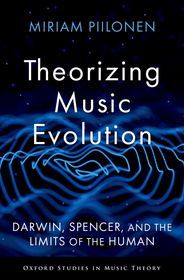
Theorizing Music Evolution
Darwin, Spencer, and the Limits of the Human
Series: Oxford Studies in Music Theory;
- Publisher's listprice GBP 62.00
-
29 620 Ft (28 210 Ft + 5% VAT)
The price is estimated because at the time of ordering we do not know what conversion rates will apply to HUF / product currency when the book arrives. In case HUF is weaker, the price increases slightly, in case HUF is stronger, the price goes lower slightly.
- Discount 10% (cc. 2 962 Ft off)
- Discounted price 26 658 Ft (25 389 Ft + 5% VAT)
Subcribe now and take benefit of a favourable price.
Subscribe
29 620 Ft

Availability
Estimated delivery time: In stock at the publisher, but not at Prospero's office. Delivery time approx. 3-5 weeks.
Not in stock at Prospero.
Why don't you give exact delivery time?
Delivery time is estimated on our previous experiences. We give estimations only, because we order from outside Hungary, and the delivery time mainly depends on how quickly the publisher supplies the book. Faster or slower deliveries both happen, but we do our best to supply as quickly as possible.
Product details:
- Publisher OUP USA
- Date of Publication 7 March 2024
- ISBN 9780197695289
- Binding Hardback
- No. of pages168 pages
- Size 163x226x27 mm
- Weight 386 g
- Language English
- Illustrations 8 b/w figures 493
Categories
Short description:
Theorizing Music Evolution is a critical examination of ideas about musical origins, with emphasis on nineteenth-century music-evolutionary texts by Charles Darwin and Herbert Spencer. In a ground-breaking contribution to music theory and histories of science, author Miriam Piilonen argues for the significance of this Victorian music-evolutionism in lights of its ties to a recently revitalized subfield of evolutionary musicology.
MoreLong description:
What did historical evolutionists such as Charles Darwin and Herbert Spencer have to say about music? What role did music play in their evolutionary theories? What were the values and limits of these evolutionist turns of thought, and in what ways have they endured in present-day music research? Theorizing Music Evolution: Darwin, Spencer, and the Limits of the Human is a critical examination of ideas about musical origins, emphasizing nineteenth-century theories of music in the evolutionist writings of Darwin and Spencer. Author Miriam Piilonen argues for the significance of this Victorian music-evolutionism in light of its ties to a recently revitalized subfield of evolutionary musicology. Taking an interdisciplinary approach to music theorizing, Piilonen explores how historical thinkers constructed music in evolutionist terms and argues for an updated understanding of music as an especially fraught area of evolutionary thought.
In this book, Piilonen delves into how historical evolutionists, in particular Darwin and Spencer, developed and applied a concept of music that served as a boundary-drawing device, used to trace or obscure the conceptual borders between human and animal. She takes as primary texts the early evolutionary treatises that double as theoretical accounts of music's origins. For Darwin, music served as a kind of proto-language common to humans and animals alike; he heard the songs of birds and the chirps of mice as musical, as articulated in texts such as The Descent of Man (1871) and The Expression of the Emotions in Man and Animals (1872). Spencer, on the other hand, viewed music as a specifically human stage of evolutionary advance, beyond language acquisition, as outlined in his essay, "The Origin and Function of Music" (1857). These competing views established radically different perspectives on the origin and function of music in human cultural expression, while at the same time being mutually constitutive of one another.
A ground-breaking contribution to music theory and histories of science, Theorizing Music Evolution turns to music evolution with an eye toward disrupting and intervening in these questions as they recur in the present.
In the resurgent field of evolutionary musicology, Miriam Piilonen's critical account of the views of Darwin, Spencer, and Edmund Gurney is a cogent, sometimes pessimistic, always welcome intervention. Highlighting the biases and limitations of nineteenth-century evolutionism and listening for their echoes today, she offers correctives for just-so stories told and retold: about music's adaptive benefits, its primordial anticipation of language, its gendered production and impact, and, most generally, its progress.
Table of Contents:
List of Figures
Introduction - Music and Evolution Revisited
The Revival of Evolutionary Musicology
Historicizing Music as a Deconstructed Thing
Evolutionary Claims are Ontological Claims
Book Structure and Chapter Summaries
Chapter 1 - Herbert Spencer Writes to Alfred Tennyson
Spencer the Evolutionist
Spencer Writes to Charles Darwin
The Shifting Terrain of Victorian Evolution Theories
Spencer's Earworm
Chapter 2 - Charles Darwin VS. Herbert Spencer on the Origins of Music
Music in Darwin's Early Notebooks and The Descent of Man
Music in Darwin's The Expression of the Emotions in Man and Animals
Spencer's Theory of Music Perception
Spencer and Darwin's Entwined Theories of Music
A Debate Without a Winner
Chapter 3 - Sound Symbolism in Spencer's Evolutionary Thought
Spencer's Evolutionary Theory of Music - Basic Theses
Sound Symbolism as Imperial Metaphor in Spencer's Evolutionary Thought
Music and Language as Constructed through Theories of Origins
Plato's Contribution: Centering Sound Symbolism
Implications and Consequences of Spencer's Sound Symbolism
Evolutionary Voices and Non-Linear Histories
Chapter 4 - The Darwinian Musical Hypothesis
What is the Darwinian Musical Hypothesis?
Antoinette Brown Blackwell's Feminist Critique of Darwin
Problems with Applying Darwin's Theory of Sexual Selection
Darwinian Musical Aesthetics
Against Adaptationism
Chapter 5 - Edmund Gurney's Darwinian Music Formalism
Gurney's Evolutionary Music Theory as Idealized Model
Gurney, Darwin, and Association
Problematizing Gurnian Formalism
Conclusion - Post-Darwinian Music Theory
A Personal Postscript
Acknowledgements
References
Index

