

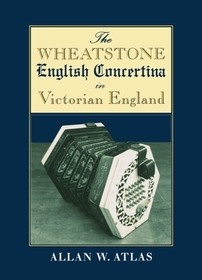
The Wheatstone English Concertina in Victorian England
- Publisher's listprice GBP 205.00
-
97 938 Ft (93 275 Ft + 5% VAT)
The price is estimated because at the time of ordering we do not know what conversion rates will apply to HUF / product currency when the book arrives. In case HUF is weaker, the price increases slightly, in case HUF is stronger, the price goes lower slightly.
- Discount 10% (cc. 9 794 Ft off)
- Discounted price 88 145 Ft (83 948 Ft + 5% VAT)
Subcribe now and take benefit of a favourable price.
Subscribe
97 938 Ft

Availability
printed on demand
Why don't you give exact delivery time?
Delivery time is estimated on our previous experiences. We give estimations only, because we order from outside Hungary, and the delivery time mainly depends on how quickly the publisher supplies the book. Faster or slower deliveries both happen, but we do our best to supply as quickly as possible.
Product details:
- Publisher OUP Oxford
- Date of Publication 24 October 1996
- ISBN 9780198165804
- Binding Hardback
- No. of pages168 pages
- Size 254x196x16 mm
- Weight 582 g
- Language English
- Illustrations 8 pp plates, figures, tables, music examples 0
Categories
Short description:
This is the first comprehensive study of the Wheatstone English concertina and its music, players, and audiences in Victorian England - at its height of popularity. Developed by the physicist Sir Charles Wheatstone about 1830, the instrument quickly found a home on the leading concert stages and in upper-class salons. It attracted such composers as Macfarren, Benedict, Barnett, and Molique, who supplied its repertory with concertos, character pieces, and chamber works, while its two great virtuosos, Giulio Regondi and Richard Blagrove, drew the plaudits from audiences and critics alike. Illustrated with music examples throughout, this study also contains a unique Appendix containing five pieces written specially for the instrument by the composers of the day.
MoreLong description:
The Wheatstone English concertina was enormously popular in Victorian England. Developed around 1830 by the physicist Sir Charles Wheatstone, the instrument quickly found a home on the leading concert stage and in upper-class salons. It attracted such composers as Macfarren, Benedict, Barnett, and molique, who supplied its repertory with concertos, sonatas, character pieces, and chamber works. It two great virtuosos, Giulio Regondi and Richard Blagrove, drew the plaudits of audiences, and critics alike.
This is the first comprehensive book about the instrument, its players, audiences, and reception. An appendix contains an edition of five pieces for the instrument.
his work on the technical aspects of the instrument and its music is thoroughly professional. For modern players of the English concertina, who are more numerous than one might have supposed, the five scores provided-two in facsimile, three newly edited-will be an invaluable resource.

