

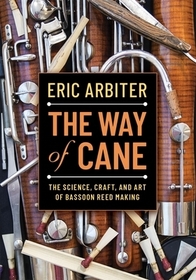
The Way of Cane
The Science, Craft, and Art of Bassoon Reed-making
- Publisher's listprice GBP 34.99
-
15 797 Ft (15 045 Ft + 5% VAT)
The price is estimated because at the time of ordering we do not know what conversion rates will apply to HUF / product currency when the book arrives. In case HUF is weaker, the price increases slightly, in case HUF is stronger, the price goes lower slightly.
- Discount 10% (cc. 1 579 Ft off)
- Discounted price 14 218 Ft (13 541 Ft + 5% VAT)
Subcribe now and take benefit of a favourable price.
Subscribe
15 797 Ft

Availability
printed on demand
Why don't you give exact delivery time?
Delivery time is estimated on our previous experiences. We give estimations only, because we order from outside Hungary, and the delivery time mainly depends on how quickly the publisher supplies the book. Faster or slower deliveries both happen, but we do our best to supply as quickly as possible.
Product details:
- Publisher OUP USA
- Date of Publication 22 September 2020
- ISBN 9780190919627
- Binding Paperback
- No. of pages350 pages
- Size 251x175x22 mm
- Weight 590 g
- Language English
- Illustrations 221 figures 23
Categories
Short description:
Written by seasoned professional bassoonist and reed maker Eric Arbiter, The Way of Cane demystifies the reed-making experience for musicians of all levels.
MoreLong description:
As the sound-producing mechanism for the bassoon, the reed is a vital component in the sound of the entire instrument. While pre-manufactured reeds are widely available for purchase at music stores, this one-size-fits-all option hardly does justice to the unique needs of the musician and the piece. Many bassoonists, including seasoned professional bassoonist Eric Arbiter, instead choose to craft their own reeds. A nuanced and difficult craft to master, reed-making involves specialized machinery and necessitates special attention to the thickness, and even topography, of the reed itself. When done correctly, however, this process results in a reed that not only produces a more beautiful sound, but also holds up to even the most demanding musical performances.
In The Way of Cane, Arbiter demystifies this process for bassoonists of all levels of experience. Drawing from his decades-long experience as both musician and reed-maker, Arbiter provides a comprehensive yet accessible overview of the craft, from the differing sound qualities produced by changing the dimensions of the reed's blades to the changes in the reed's behaviors as it passes through cycles of wetting and drying during production. Small changes in each of these variables, Arbiter explains, contribute to the ultimate goal of producing a bassoonist's ideal sound. With step-by-step instructions, detailed photos that further illuminate the reed-making process, and a companion website featuring the author's own recordings. The Way of Cane emphasizes the importance of the reed to the bassoon's sound, as well as the harmony between reed and musician.
Nothing like this outstanding volume exists anywhere. The language is easy to understand, and is a 'must read' for those seriously studying the bassoon. It contains a thorough guide to bassoon reed-making, from elementary procedures to professional methods. The book goes beyond reed-making to present information about fingerings, articulations, and many of the musical problems a professional bassoonist has to learn and solve.
Table of Contents:
Introduction
Dedication
Acknowledgements
Part I: Foundations
1. Underlying Direction
2. Beginner's Mind and Not Knowing
3. Musical Influences and Reed-Making
4. Test It For Yourself
5. Machines for Bassoonists On a Limited Reed-making Budget
6. Using a Dial Indicator
7. Chains of Causes and Conditions in Reed-work
8. The Embouchure And Its Relationship To The Tip Opening
9. Bocals
10. Cycles of Reeds
11. The Study of Cane. Size, straightness and density
Part II: Reed-making procedures
12. Gouging
13. Some Thoughts about Shapers
14. Some Thoughts About Profile Types
15. Forming the Tube, Beveling and Wrapping
16. Finishing Strategies
Workflow Chart for the Way of Cane
Part III: Performance
17. The Reed Notebook
18. More on Fingerings
19. Efficient Practicing
20. Prolonging A Reed's Life
21. Tonguing and Double-Tonguing
22. Notes for the Recordings
Part IV: Supplemental Material
23. Adjusting and Setting Reed Machines
24. Cane Hardness Testing
25. A Correspondence with Norman Herzberg
26. Auditions
A Summary of the Way of Cane
Afterword
Appendices
Bibliography

