

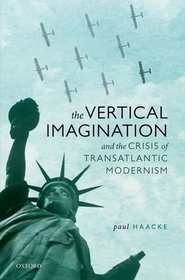
The Vertical Imagination and the Crisis of Transatlantic Modernism
- Publisher's listprice GBP 135.00
-
60 952 Ft (58 050 Ft + 5% VAT)
The price is estimated because at the time of ordering we do not know what conversion rates will apply to HUF / product currency when the book arrives. In case HUF is weaker, the price increases slightly, in case HUF is stronger, the price goes lower slightly.
- Discount 10% (cc. 6 095 Ft off)
- Discounted price 54 857 Ft (52 245 Ft + 5% VAT)
Subcribe now and take benefit of a favourable price.
Subscribe
60 952 Ft

Availability
printed on demand
Why don't you give exact delivery time?
Delivery time is estimated on our previous experiences. We give estimations only, because we order from outside Hungary, and the delivery time mainly depends on how quickly the publisher supplies the book. Faster or slower deliveries both happen, but we do our best to supply as quickly as possible.
Product details:
- Publisher OUP Oxford
- Date of Publication 11 March 2021
- ISBN 9780198851448
- Binding Hardback
- No. of pages380 pages
- Size 241x164x26 mm
- Weight 746 g
- Language English
- Illustrations 23 Illustrations 109
Categories
Short description:
Examines the uses of vertical metaphors across a broad canvas of American, English, and European fiction, poetry, and film in the modern period.
MoreLong description:
From the invention of skyscrapers and airplanes to the development of the nuclear bomb, ideas about the modern increasingly revolved around vertiginous images of elevation and decline and new technologies of mobility and terror from above. In The Vertical Imagination and the Crisis of Transatlantic Modernism, Paul Haacke examines this turn by focusing on discourses of aspiration, catastrophe, and power in major works of European and American literature as well as film, architecture, and intellectual and cultural history.
This wide-ranging and pointed study begins with canonical fiction by Franz Kafka, Virginia Woolf, James Joyce, and John Dos Passos, as well as poetry by Guillaume Apollinaire, Hart Crane, and Aimé Césaire, before moving to critical reflections on the rise of New York City by architects and writers from Le Corbusier to Simone de Beauvoir, the films of Alfred Hitchcock and theories of cinematic space and time, and postwar novels by Kurt Vonnegut, Thomas Pynchon, and Leslie Marmon Silko, among many other examples. In tracing the rise and fall of modernist discourse over the course of the long twentieth century, this book shows how visions of vertical ascension turned from established ideas about nature, the body, and religion to growing anxieties about aesthetic distinction, technological advancement, and American capitalism and empire. It argues that spectacles of height and flight became symbols and icons of ambition as well as direct indexes of power, and thus that the vertical transformation of modernity was both material and imagined, taking place at the same time through the rapidly expanding built environment and shifting ideological constructions of "high" and "low."
Haacke's book offers an erudite, brilliantly detailed compendium of early twentieth century cultural work, crossing boundaries of nation, genre, and discipline with the agility and breadth characteristic of the best in modernist thought.
Table of Contents:
Introduction: The Vertical Turn
Transatlantic Topographies
Vertiginous Aspiration
Enchanted Catastrophe
Cinematic Terror
Critical Suspension
Coda: On the Horizon

