

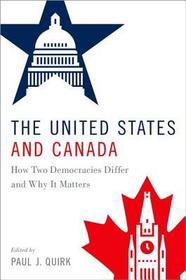
The United States and Canada
How Two Democracies Differ and Why It Matters
- Publisher's listprice GBP 55.00
-
24 832 Ft (23 650 Ft + 5% VAT)
The price is estimated because at the time of ordering we do not know what conversion rates will apply to HUF / product currency when the book arrives. In case HUF is weaker, the price increases slightly, in case HUF is stronger, the price goes lower slightly.
- Discount 10% (cc. 2 483 Ft off)
- Discounted price 22 349 Ft (21 285 Ft + 5% VAT)
Subcribe now and take benefit of a favourable price.
Subscribe
24 832 Ft

Availability
Estimated delivery time: In stock at the publisher, but not at Prospero's office. Delivery time approx. 3-5 weeks.
Not in stock at Prospero.
Why don't you give exact delivery time?
Delivery time is estimated on our previous experiences. We give estimations only, because we order from outside Hungary, and the delivery time mainly depends on how quickly the publisher supplies the book. Faster or slower deliveries both happen, but we do our best to supply as quickly as possible.
Product details:
- Publisher OUP USA
- Date of Publication 16 September 2019
- ISBN 9780190870836
- Binding Paperback
- No. of pages376 pages
- Size 231x155x30 mm
- Weight 885 g
- Language English
- Illustrations 21 black and white illustrations 0
Categories
Short description:
This edited volume presents an integrated comparative examination of the political systems of the United States and Canada-with special attention to the effects of political institutions, and their interaction with political values and other factors, in policymaking. It explores, in particular, the differences between the American presidential (or separation-of-powers) system and the Canadian parliamentary system. It also considers a number of further institutional differences-concerning federalism, bureaucratic leadership, judicial definitions of citizens' rights, and others.
MoreLong description:
The United States and Canada share the longest border in the world, maintain one of the closest alliances, and are notably similar in many ways. Yet the two countries also have important differences, including sharply contrasting political institutions. In The United States and Canada, Paul J. Quirk has gathered a distinguished cast of contributors to present an integrated comparative examination of the political systems of the United States and Canada-with special attention to the effects of political institutions and their interaction with political values, geographic and demographic factors, and other influences. The volume explores the differences between the American presidential (or separation-of-powers) system and the Canadian parliamentary system-focusing on electoral and party systems, executive leadership and the legislative process, bureaucratic influence, and federalism. It proceeds to examine patterns of governance in a wide range of issue areas: economic policy; climate-change policy; healthcare policy; civil rights/integration and immigration; and abortion and gay rights. A sweeping comparative account, this volume serves as an authoritative guide for anyone interested in why the two countries differ and where they might be headed.
MoreTable of Contents:
Part One: Introduction
Chapter 1. Introduction
Paul J. Quirk
Part Two: Political Culture and Institutions
Chapter 2. Political Culture and Values
Russell J. Dalton
Chapter 3. Electoral and Party Systems
Andr-- Blais, Shaun Bowler, and Bernard Grofman
Chapter 4. Executive Leadership and the Legislative Process
Jonathan Malloy and Paul J. Quirk
Chapter 5. Bureaucratic Influence and Policymaking
John R. McAndrews, Bert A. Rockman, and Colin Campbell
Chapter 6. Federalism
Richard Simeon and Beryl A. Radin
Part Three: Policies and Outcomes
Chapter 7. Economic Policy: Growth, Stabilization and Distribution
William Keech and William Scarth
Chapter 8. Environmental Policy: Climate Change
Kathryn Harrison
Chapter 9. Morality Issues: Abortion and Gay Rights
Gary Mucciaroni and Francesca Scala
Chapter 10. Health Care in Canada and the United States
Theodore R. Marmor and Antonia Maioni
Chapter 11. Managing Diversity: Civil Rights and Immigration
Irene Bloemraad and Doris Marie Provine
Chapter 12. Assessing Performance: National Versus Regional Patterns
Keith Banting, Jack Nagel, Chelsea Schafer, and Daniel Westlake
Part Four: Conclusions
Chapter 13. Lessons of Comparison: Institutions and Governance
Paul J. Quirk

