

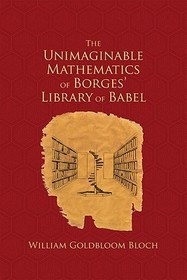
The Unimaginable Mathematics of Borges' Library of Babel
- Publisher's listprice GBP 27.49
-
12 411 Ft (11 820 Ft + 5% VAT)
The price is estimated because at the time of ordering we do not know what conversion rates will apply to HUF / product currency when the book arrives. In case HUF is weaker, the price increases slightly, in case HUF is stronger, the price goes lower slightly.
- Discount 10% (cc. 1 241 Ft off)
- Discounted price 11 170 Ft (10 638 Ft + 5% VAT)
Subcribe now and take benefit of a favourable price.
Subscribe
12 411 Ft

Availability
printed on demand
Why don't you give exact delivery time?
Delivery time is estimated on our previous experiences. We give estimations only, because we order from outside Hungary, and the delivery time mainly depends on how quickly the publisher supplies the book. Faster or slower deliveries both happen, but we do our best to supply as quickly as possible.
Product details:
- Edition number and title Bach
- Publisher OUP USA
- Date of Publication 21 August 2008
- ISBN 9780195334579
- Binding Hardback
- No. of pages224 pages
- Size 213x147x22 mm
- Weight 386 g
- Language English
- Illustrations 60 line illustrations 0
Categories
Long description:
The Library of Babel is arguably Jorge Luis Borges' best known story-memorialized along with Borges on an Argentine postage stamp. Now, in The Unimaginable Mathematics of Borges' Library of Babel, William Goldbloom Bloch takes readers on a fascinating tour of the mathematical ideas hidden within one of the classic works of modern literature.
Written in the vein of Douglas R. Hofstadter's Pulitzer Prize-winning Gödel, Escher, Bach, this original and imaginative book sheds light on one of Borges' most complex, richly layered works. Bloch begins each chapter with a mathematical idea-combinatorics, topology, geometry, information theory-followed by examples and illustrations that put flesh on the theoretical bones. In this way, he provides many fascinating insights into Borges' Library. He explains, for instance, a straightforward way to calculate how many books are in the Library-an easily notated but literally unimaginable number-and also shows that, if each book were the size of a grain of sand, the entire universe could only hold a fraction of the books in the Library. Indeed, if each book were the size of a proton, our universe would still not be big enough to hold anywhere near all the books.
Given Borges' well-known affection for mathematics, this exploration of the story through the eyes of a humanistic mathematician makes a unique and important contribution to the body of Borgesian criticism. Bloch not only illuminates one of the great short stories of modern literature but also exposes the reader-including those more inclined to the literary world-to many intriguing and entrancing mathematical ideas.
Table of Contents:
Preface
Introduction
Combinatorics: Contemplating Variations of the 23 Letter
Topology and Cosmology: The Universe (Which Others Call the Library)
Information Theory: Cataloging the Collection
Geometry and Graph Theory: Ambiguity and Access
Real Analysis: The Book of Sand
More Combinatorics: Disorderings into Order
A Homomorphism: Structure into Meaning
Critical Points
Openings
Acknowledgements
Appendix IThe Logos of Logarithms
Appendix IIFlat-Out Disoriented
Appendix IIIPeeling the 3-Sphere
Appendix IVA Labyrinth, not a Maze
Appendix VAn Example of the Ars Combinatoria
Bibliography

