

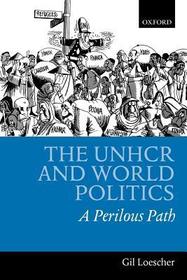
The UNHCR and World Politics
A Perilous Path
- Publisher's listprice GBP 84.00
-
40 131 Ft (38 220 Ft + 5% VAT)
The price is estimated because at the time of ordering we do not know what conversion rates will apply to HUF / product currency when the book arrives. In case HUF is weaker, the price increases slightly, in case HUF is stronger, the price goes lower slightly.
- Discount 10% (cc. 4 013 Ft off)
- Discounted price 36 118 Ft (34 398 Ft + 5% VAT)
Subcribe now and take benefit of a favourable price.
Subscribe
40 131 Ft

Availability
printed on demand
Why don't you give exact delivery time?
Delivery time is estimated on our previous experiences. We give estimations only, because we order from outside Hungary, and the delivery time mainly depends on how quickly the publisher supplies the book. Faster or slower deliveries both happen, but we do our best to supply as quickly as possible.
Product details:
- Publisher OUP Oxford
- Date of Publication 24 May 2001
- ISBN 9780199246915
- Binding Paperback
- No. of pages446 pages
- Size 234x157x24 mm
- Weight 646 g
- Language English 0
Categories
Short description:
This book examines the role of UNHCR in world politics since its founding 50 years ago, its relevance towards reaching solutions to global refugee problems, and its effectiveness as the international community's principal protection mechanism for persecuted populations who have been forced into exile. The author raises questions about the adequacy of the agency's mandate in contemporary world politics and the appropriate role of an intergovernmental agency in balancing the protection of individual and group rights against the sovereign prerogatives and interests of states. In addition to analyzing the difficulties of resolving past refugee crises, the author offers bold policy recommendations as to how to cope more effectively with future refugee problems.
MoreLong description:
Over fifty years ago governments established the Office of the United Nations High Commissioner for Refugees (UNHCR) to protect the world's refugees. The UNHCR was created to be a human rights and advocacy organization. But governments also created the agency to promote regional and international stability and to serve the interests of states. Consequently, the UNHCR has always trod a perilous path between its mandate to protect refugees and asylum seekers and the demands placed upon it by states to be a relevant actor in world politics.
This is the first independent history of the UNHCR. Gil Loescher, one of the world's leading experts on refugee affairs, draws upon decades of personal experience and research to examine the origins and evolution of the UNHCR as well as to identify many of the major challenges facing the organization in the years ahead. A key focus is to examine the extent to which the evolution of the UNHCR has been framed by the crucial events of international politics during the past half century and how, in turn, the actions of the eight past High Commissioners have helped shape the course of world history.
Each chapter tells the story of an individual High Commissioner and examines the unique contributions made to the development of the Office. The history of the last fifty years shows how the UNHCR has initiated and capitalized on international political developments to progressively expand its scope and authority as an important actor in world politics.
The book argues that the UNHCR has overstretched itself in recent decades and has strayed from its central human rights protection role. The protection of refugees remains a litmus test of the international community's commitment to defend human rights and to uphold liberal democratic values. Loescher offers a series of bold policy recommendations aimed at making the agency a more effective and accountable advocate for the millions of refugees in the world today.
Gill Loescher is overwhelmingly good on the decision-making of past High Commissioners as it relates to the international operations of the UNHCR, and the internal bureaucracy of the UNHCR insofar as this affects its operational capacity. In its detail on those operations Loescher's book does exactly what it says on the tin, and is the superlative modern political history of the UNHCR.
Table of Contents:
The UNHCR at 50: State Pressures and Institutional Autonomy
International Recognition of Refugees
The Cold War Origins of the UNHCR under Gerrit Jan van Heuven Goedhart
The Emerging Independence of the UNHCR under Auguste Lindt
'The Good Offices' and Expansion into Africa under Felix Schnyder
The Global Expansion of the UNHCR under Prince Sadruddin Aga Khan
The New Cold War and the UNCHR under Poul Hartling
The UNHCR's 'New Look', Financial Crisis, and Collapse of Morale under Jean-Pierre Hocke and Thorvald Stoltenberg
The Post-Cold War Era and the UNHCR under Sadako Ogata
Towards the Future: the UNHCR in the Twenty-First Century

