

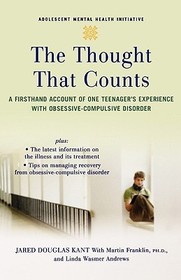
The Thought That Counts
A Firsthand Account of One Teenager's Experience with Obsessive-Compulsive Disorder
Series: Adolescent Mental Health Initiative;
- Publisher's listprice GBP 13.49
-
6 090 Ft (5 800 Ft + 5% VAT)
The price is estimated because at the time of ordering we do not know what conversion rates will apply to HUF / product currency when the book arrives. In case HUF is weaker, the price increases slightly, in case HUF is stronger, the price goes lower slightly.
- Discount 10% (cc. 609 Ft off)
- Discounted price 5 481 Ft (5 220 Ft + 5% VAT)
Subcribe now and take benefit of a favourable price.
Subscribe
6 090 Ft

Availability
printed on demand
Why don't you give exact delivery time?
Delivery time is estimated on our previous experiences. We give estimations only, because we order from outside Hungary, and the delivery time mainly depends on how quickly the publisher supplies the book. Faster or slower deliveries both happen, but we do our best to supply as quickly as possible.
Product details:
- Publisher OUP USA
- Date of Publication 24 April 2008
- ISBN 9780195316896
- Binding Paperback
- No. of pages192 pages
- Size 210x152x13 mm
- Weight 263 g
- Language English
- Illustrations Includes text boxes 0
Categories
Short description:
In this book for young people who have been diagnosed with obsessive-compulsive disorder (OCD), Jared Kant discusses his own experiences with the illness, and the disruption and distress that it brought to his life as an adolescent. Combining this personal story with a candid and easy-to-understand description of the science behind OCD, Kant (now an adult who healthily and successfully manages his illness) also provides the facts that young people diagnosed with OCD need, such as how to find professional help, what types of therapies are available for this disorder, and how to deal with stressful situations at home and at school.
MoreLong description:
In this book for young people who have been diagnosed with obsessive-compulsive disorder (OCD), Jared Kant discusses his own experiences with the illness, and the disruption and distress that it brought to his life as an adolescent. Combining this personal story with a candid and easy-to-understand description of the science behind OCD, Kant (now an adult who healthily and successfully manages his illness) also provides the facts that young people diagnosed with OCD need, such as how to find professional help, what types of therapies are available for this disorder, and how to deal with stressful situations at home and at school.
This book would be helpful for those who are diagnosed with OCD at a young age.

